

India’s Coal Industry: Powering Growth While Preparing for an Energy Transition
By Forever News Editorial Desk
India’s coal industry continues to be the backbone of the nation’s energy security despite the country’s rapid expansion in renewable energy. Coal remains the single largest source of electricity generation, fuelling industries, powering households, and supporting economic growth. While India has made significant strides in solar and wind energy, coal is expected to remain a critical component of the country’s energy mix for the foreseeable future.
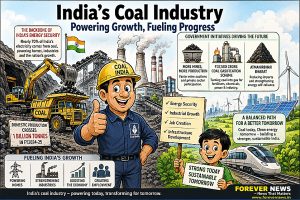
The Indian coal industry stands at a defining moment.
Coal Continues to Drive India’s Economy
India is the world’s second-largest producer and consumer of coal. The fuel accounts for nearly 70% of the country’s electricity generation, making it indispensable for meeting rising energy demand driven by industrialisation, urbanisation, and increasing household consumption.
The government has focused on increasing domestic coal production to reduce dependence on imports, improve energy security, and support the vision of Atmanirbhar Bharat. Domestic coal production crossed 1 billion tonnes in FY2024-25, marking another milestone for the sector.
Coal India Remains the Industry Leader
Coal India Limited continues to dominate the domestic coal sector, accounting for the majority of India’s coal production.
However, the company has faced some short-term challenges. Its latest quarterly results reflected pressure from weaker production volumes and rising operational costs, even as demand for coal remains robust. The market reacted cautiously following the earnings announcement.
Despite these headwinds, Coal India has announced an ambitious ₹68,000 crore capital expenditure programme between FY27 and FY30 to expand mining capacity, modernise infrastructure, improve logistics, and diversify into new business opportunities.
Government Push for Self-Reliance
The Ministry of Coal has accelerated commercial coal mining, faster mine auctions, private sector participation, and modern mining technologies. It is also promoting domestic production of coking coal to reduce reliance on imports used by the steel industry. The government’s long-term target is to significantly increase domestic coking coal production by 2030.
In another strategic move, the Union Cabinet has approved a ₹37,500 crore scheme to promote coal gasification projects. Coal gasification converts coal into synthetic gas that can be used in fertilisers, chemicals, power generation, and other industrial applications while reducing dependence on imported fuels.
Imports Show Signs of Moderation
India has traditionally imported both thermal coal and coking coal. However, recent trends indicate that thermal coal imports have moderated due to increased domestic production and relatively high international prices. Even as other Asian countries increased imports this summer, India’s imports declined.
The exception remains coking coal, where India continues to rely heavily on imports because domestic reserves are limited in quality. With India’s steel production expected to expand substantially over the coming decade, demand for imported coking coal is likely to remain strong.
Renewable Energy is Growing, But Coal Remains Essential
India is simultaneously pursuing one of the world’s largest renewable energy programmes.
Solar, wind, hydro, and green hydrogen investments are expanding rapidly. Nevertheless, renewable energy is intermittent, and coal-fired power plants continue to provide reliable baseload electricity, especially during peak demand and periods of low renewable generation.
Recent data shows coal still supplied roughly 70% of India’s electricity, and an even higher share during evening peak demand, underscoring its continuing importance to grid stability.
Key Challenges Facing the Industry
The coal sector faces several long-term challenges:
- Meeting stricter environmental standards.
- Reducing carbon emissions and improving sustainability.
- Faster land acquisition and environmental clearances.
- Modernising mining operations through automation and digital technologies.
- Managing logistics efficiently to ensure uninterrupted coal supplies.
- Balancing economic growth with India’s climate commitments.
The industry must also improve mine safety, rehabilitation of mined areas, and community development in coal-bearing regions.
The Road Ahead
Industry experts believe coal demand in India will continue to grow over the next decade, even as its percentage share in the overall energy mix gradually declines with the expansion of renewable energy. International agencies also project India to remain the principal driver of global coal demand growth through the remainder of the decade.
India’s strategy is therefore not an abrupt exit from coal but a balanced energy transition—using domestic coal to ensure energy security while simultaneously accelerating investments in cleaner technologies, renewable energy, and low-carbon industrial processes.
Conclusion
The Indian coal industry stands at a defining moment. It is powering one of the world’s fastest-growing economies while adapting to the realities of climate change and the global transition towards cleaner energy.
With continued policy support, investments in technology, higher domestic production, and responsible environmental management, the sector is expected to remain a cornerstone of India’s energy landscape for many years to come.
As India balances economic growth with sustainability, the challenge will not be choosing between coal and renewables—but ensuring that both work together to power a secure, affordable, and cleaner energy future.