
Forever News
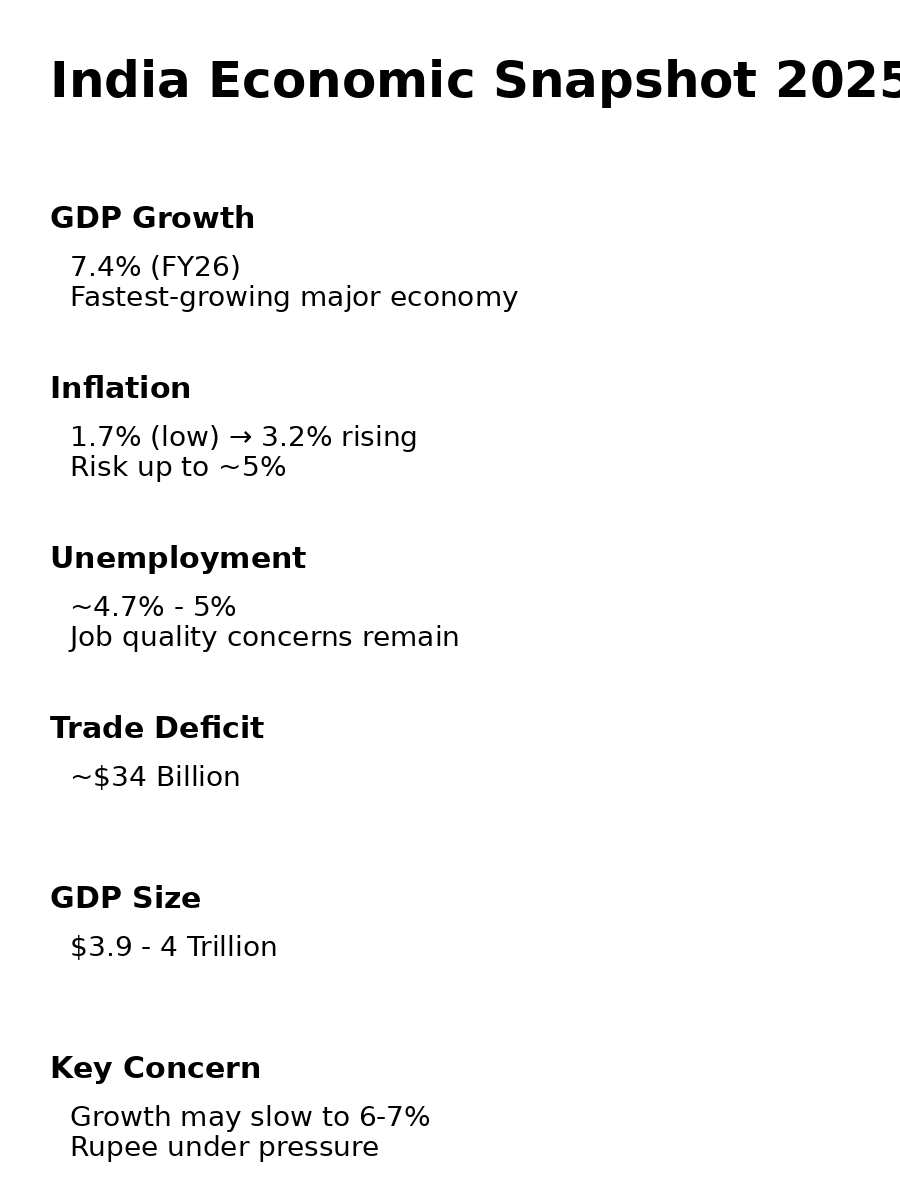
India’s Growth Story Needs Depth, Not Just Speed. India continues to stand at a critical juncture in its economic journey. With strong GDP projections, rising global interest, and a rapidly expanding digital ecosystem, the country is often showcased as the world’s fastest-growing major economy. Yet, beneath this optimism lies a deeper question: is India’s growth truly inclusive, resilient, and sustainable?
Recent economic indicators paint a mixed picture. On one hand, sectors like IT, infrastructure, and manufacturing are showing renewed momentum. Government initiatives such as “Make in India,” “Digital India,” and production-linked incentive (PLI) schemes have begun to yield visible results. Exports in select sectors, particularly electronics and defence, are scaling new highs, signaling India’s ambition to emerge as a global manufacturing hub.
However, growth in numbers alone does not translate into equitable development. A significant portion of India’s population still grapples with underemployment, stagnant wages, and rising living costs. The urban-rural divide continues to widen, and while metropolitan cities surge ahead with innovation and investment, smaller towns and villages struggle to keep pace.
One of the most pressing concerns remains job creation. India’s demographic dividend—its young and growing workforce—can quickly turn into a liability if meaningful employment opportunities are not generated at scale. While startups and the gig economy have opened new avenues, they often lack job security and long-term stability. The need of the hour is a robust framework that promotes not just entrepreneurship, but also sustainable and secure employment across sectors.
Inflation is another silent pressure point. While macroeconomic stability has largely been maintained, everyday expenses—particularly food, fuel, and housing—continue to strain household budgets. For the middle class and economically weaker sections, this translates into reduced purchasing power, which in turn affects overall demand in the economy.
At the same time, India’s global positioning is undergoing a transformation. Geopolitical shifts and supply chain realignments have created opportunities for the country to attract foreign investment and expand its export footprint. But capitalizing on these opportunities requires more than policy announcements—it demands consistent execution, ease of doing business, and regulatory clarity.
Equally important is the issue of information credibility in today’s hyper-connected age. With the rapid spread of digital media, misinformation can shape public perception and influence economic behavior. Strengthening institutional mechanisms to ensure transparency and accuracy in communication is essential for maintaining trust—both domestically and internationally.
The financial sector, too, must remain vigilant. While banking reforms and regulatory oversight have improved significantly over the years, rising retail credit and market volatility call for cautious optimism. Ensuring that growth is not driven by unsustainable borrowing is key to long-term stability.
India’s path forward lies in balancing ambition with accountability. Policymakers must focus not only on headline growth figures but also on the quality of that growth. Investments in education, healthcare, and skill development will be crucial in building a resilient workforce. Infrastructure development must be complemented by environmental sustainability, ensuring that progress today does not come at the cost of tomorrow.
Moreover, cooperative federalism—where states play an active role in driving reforms and innovation—can accelerate inclusive growth. Regional strengths must be leveraged to create a more balanced and diversified economic landscape.
In conclusion, India’s growth story is undoubtedly compelling, but it is still a work in progress. The challenge is not just to grow fast, but to grow right. A nation of over a billion people cannot rely solely on momentum; it must build depth, resilience, and inclusivity into its development model.
The coming years will determine whether India can truly transform its potential into lasting prosperity. The direction is promising—but the journey demands careful navigation.