
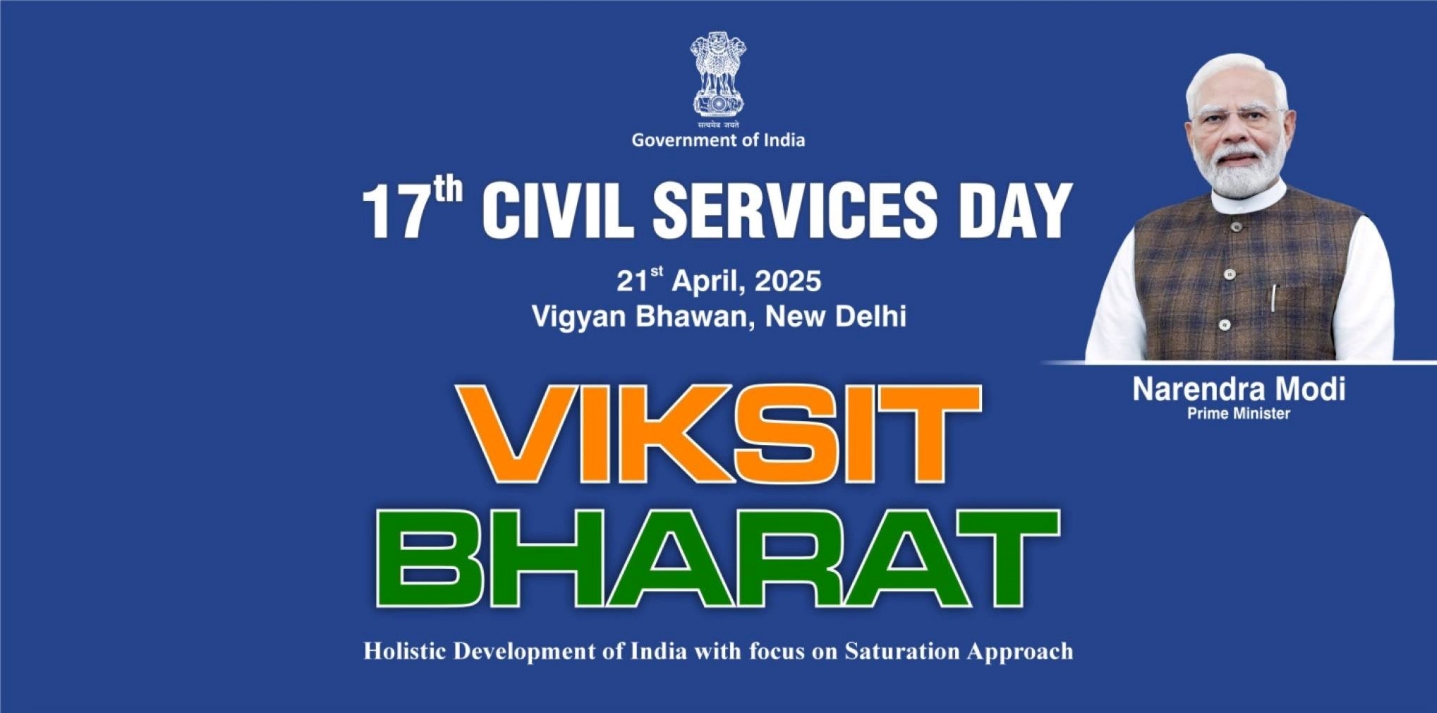
Prime Minister Narendra Modi addressed the 17th Civil Services Day with a powerful call to action, envisioning a modern, tech-savvy, and citizen-centric civil service as the backbone of a “Viksit Bharat” or Developed India. Speaking to a gathering of senior officials, policy makers, and civil servants from across the nation, the Prime Minister urged for a transformative shift in both mindset and machinery, underscoring the urgency of reform, innovation, and deep societal impact in governance.
The event held a special significance this year, coinciding with the 75th year of the Constitution of India and the 150th birth anniversary of Sardar Vallabhbhai Patel, the statesman who once described civil servants as the “Steel Frame of India.” Modi paid homage to Patel, reiterating his legacy of honesty, discipline, and democratic service, while pushing for civil servants to go beyond routine governance and align their roles with national aspirations for the next millennium.
Framing the moment as historic, Modi noted that this is the 25th year of the century and the new millennium. “We are laying the foundation for the next thousand years,” he said, emphasizing that hard work, not fate, will shape India’s destiny. The message was clear—bureaucracy must be proactive, future-ready, and deeply engaged in the goal of making India the third-largest economy in the world.
The Prime Minister applauded the theme of the day—“Holistic Development of India”—and interpreted it as a solemn commitment to ensure that no village, family, or citizen is left behind. Holistic development, he said, is not about incremental improvements but full-scale impact. “Clean water in every home, quality education for every child, financial access for entrepreneurs, and digital benefits for every village” must be the standard of success. Citing examples from districts like Rajkot, Tinsukia, and Koraput, Modi highlighted how grassroots efforts have transformed indicators like school attendance, solar adoption, and public health outcomes.
Modi spoke at length about the “Aspirational Blocks” program launched in 2023, crediting it with remarkable improvements in remote regions. In Piplu, Rajasthan, accurate health tracking in Anganwadis rose from 20% to 99%. In Bihar’s Jagdishpur, early pregnancy registration jumped from 25% to over 90%. Institutional deliveries in Marwah, Jammu & Kashmir, increased from 30% to 100%, while Jharkhand’s Gurdi block achieved complete tap water connectivity. These are not just statistics, he said, but a testament to effective last-mile delivery and the power of focused planning and execution.
Over the past decade, Modi argued, India has moved from incremental governance to impactful transformation. He cited examples like over 40,000 compliance requirements eliminated and more than 3,400 legal provisions decriminalized—steps that facilitated ease of doing business and reflected the government’s “Next Generation Reforms.” India’s successful G20 Presidency, which featured 200-plus meetings in over 60 cities, was also touted as proof of India’s inclusive and decentralized governance model.
The Prime Minister emphasized that old bureaucratic mindsets and resistance to reform can no longer be tolerated. Recounting his experience during decriminalization efforts, he revealed how many questioned the need for change, preferring status quo. But, he asserted, “If we keep following the old paths, new results will be hard to come by.” It is by daring to be different that India has surged ahead in the global investment and business climate.
While acknowledging past achievements, Modi declared that the future demands even more. He pointed to major milestones—building three million more homes for the poor, achieving universal tap water coverage, and introducing advanced waste management systems following the successful construction of over 110 million toilets. He also highlighted the transformation in healthcare access, with millions of poor citizens now receiving free treatment worth up to 500,000 rupees. This approach, he said, helped lift 250 million people out of poverty in the last 10 years.
The Prime Minister emphasized the evolving role of civil servants—from regulators to enablers. He cited the Mission Manufacturing initiative and stressed the critical role of MSMEs in making India a competitive player in global supply chains. In a globalized economy, he said, ease of compliance is as crucial as the quality of products. “If a small country offers better compliance norms, it will outcompete us,” he warned. Therefore, India’s bureaucracy must aim for global best practices in governance and facilitation.
Modi outlined a bold technological vision, urging civil servants to be “future-ready.” The age of Artificial Intelligence and Quantum Physics is arriving fast, and he encouraged leveraging data-driven decision-making, digital tools, and innovation to deliver citizen-centric governance. Initiatives like Mission Karmayogi and the Civil Services Capacity Building Programme, he said, are crucial to empowering the bureaucracy for this tech-driven transformation.
He also cautioned about global risks—from food and water insecurity to climate change, pandemics, and cyber threats. The interconnectedness of domestic and foreign policy challenges, especially for the Global South, calls for local-level strategies rooted in resilient development models.
Reiterating his Red Fort vision of the “Panch Pran” or five national vows—developed India, freedom from slavery mindset, pride in heritage, unity, and duty—Modi described civil servants as the chief carriers of these vows. “Every time you prioritize integrity over convenience, innovation over inertia, or service over status, you are moving the nation forward,” he declared.
To new officers, he offered a heartfelt message: “No one succeeds alone—society lifts us all.” Civil servants, he reminded, are uniquely privileged with the opportunity to give back on a national scale. They must now reimagine reform, scale up innovations, and always listen to the voice of the poor. “The citizen is god,” he proclaimed, urging a shift to ‘Nagrik Devo Bhava’ as a guiding mantra.
Concluding with a poetic vision of India’s future, he looked at a young girl in the audience and imagined her taking the place of today’s officers in 2047. “These are the dreams we must own,” he said. “This should be the goal of our ‘Viksit Bharat’.”