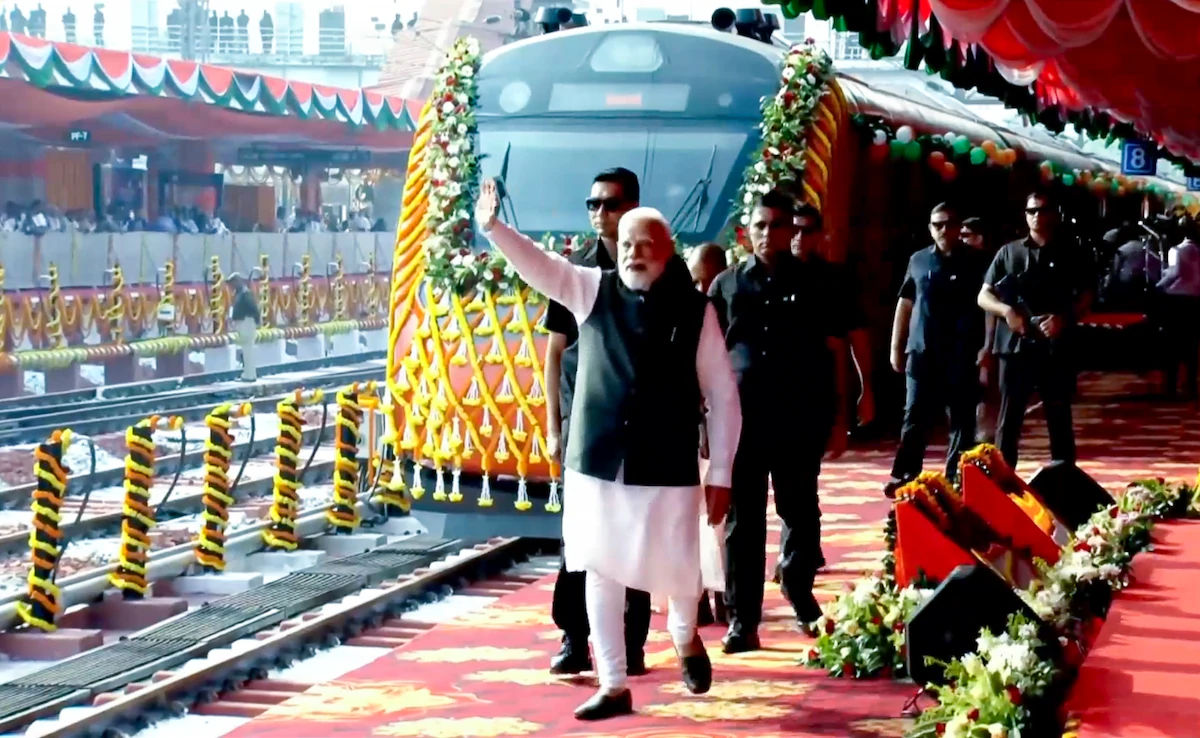

Prime Minister Narendra Modi flagged off four new Vande Bharat Express trains from Varanasi, marking a significant expansion in India’s high-speed rail network. The newly inaugurated routes include Kashi-Khajuraho, Firozpur-Delhi, Lucknow-Saharanpur, and Ernakulam-Bengaluru, bringing the total number of operational Vande Bharat trains to over 160 nationwide.
Speaking from the sacred city of Kashi, Modi emphasized that robust infrastructure is the cornerstone of economic progress, citing global examples where development followed the laying of railway tracks and construction of roads. He asserted that infrastructure is not limited to grand highways and bridges but includes every facility that catalyzes regional growth—from airports and railways to internet connectivity and healthcare.
The Prime Minister hailed the Vande Bharat initiative as a symbol of national pride, describing it as a train “made in Bharat, by Indians, for Indians.” He noted that foreign travelers are increasingly impressed by the technological strides India has made, and that the Vande Bharat, Namo Bharat, and Amrit Bharat trains represent a generational transformation of Indian Railways.
Modi highlighted the cultural and economic significance of connecting pilgrimage sites through the Vande Bharat network. Cities like Prayagraj, Ayodhya, Haridwar, Chitrakoot, and Kurukshetra are not only spiritual centers but also engines of economic activity. He revealed that 11 crore devotees visited Kashi last year alone, while Ayodhya saw over 6 crore pilgrims since the construction of the Ram Temple. These visits have injected thousands of crores into Uttar Pradesh’s economy, creating income opportunities for hoteliers, traders, transporters, artisans, and boatmen. In Banaras, youth are launching ventures in transport and traditional crafts like Banarasi sarees, signaling a wave of grassroots entrepreneurship.
The Prime Minister reiterated his government’s commitment to the mantra “Viksit Kashi to Viksit Bharat,” pointing to ongoing infrastructure projects in Varanasi. These include hospital upgrades, road expansions, gas pipelines, internet connectivity, and the ropeway project. Sports facilities like the Ganjari and Sigra stadiums are also under development, aimed at enhancing the city’s appeal for residents and visitors alike.
Modi reflected on the transformation in healthcare access in Kashi over the past decade. Previously, Banaras Hindu University was the sole option for serious medical cases, often forcing families to travel to Mumbai for treatment. Today, facilities like Mahamana Cancer Hospital, Shankar Netralaya, BHU’s Trauma Centre and Shatabdi Hospital, and the Divisional Hospital in Pandeypur have become regional lifelines. He credited Ayushman Bharat and Jan Aushadhi Kendras for reducing medical expenses for lakhs of poor families, positioning Kashi as the health capital of Purvanchal and neighboring states.
During the event, Modi interacted with schoolchildren aboard the Vande Bharat train, praising their creativity in painting and poetry competitions themed around development, safety, and national pride. He was particularly moved by a child with a hand disability who produced an exceptional painting. Inspired by their talent, Modi proposed organizing a national ‘kavi sammelan’ to showcase the work of young poets from Kashi.
Concluding his address, Modi expressed gratitude to the citizens of Kashi and India for their support and enthusiasm. He reaffirmed his vision of a developed India rooted in cultural pride, technological advancement, and inclusive growth.