

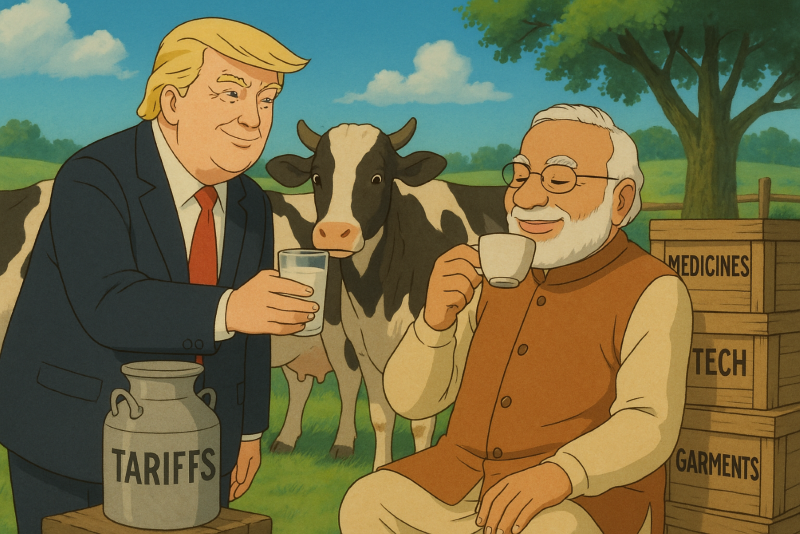
As Donald Trump pushes for a revival of protectionist policies in his second term, murmurs from Washington suggest a renewed interest in imposing tariffs on key Indian exports. The former and now returning U.S. president has long accused India of “taking advantage” of American markets. Yet, if Trump follows through on renewed tariffs—especially on Indian pharmaceuticals, textiles, and technology components—the result may not just be a jolt to India’s exports, but a strategic misstep that undercuts the United States’ own economic and geopolitical interests.
India is not China. While Washington’s decoupling strategy from Beijing has partial bipartisan support, India is viewed as a counterweight to Chinese influence in Asia. Tariffs risk alienating a vital democratic partner in the Indo-Pacific, just as both nations attempt to deepen cooperation in defense, cybersecurity, and semiconductor supply chains. Trump’s transactional approach to diplomacy—where tariffs are tools of leverage rather than targeted policy—is ill-suited for navigating the nuanced, layered relationship with New Delhi.
The most immediate blowback could come in the form of pharmaceutical disruption. India supplies over 40% of the generic drugs used in the United States. These include life-saving medicines for cancer, diabetes, heart disease, and antibiotics that are critical to the public health system. Tariffs on these goods would inevitably push up costs for U.S. consumers and strain Medicaid and Medicare budgets—contradicting Trump’s promises of lowering drug prices.
Likewise, India’s textile and garment industry is a major player in low-cost apparel sold in American stores. Any increase in tariffs on garments or raw textiles would ripple down to retail prices in Walmart, Target, and Amazon—hurting the very middle-class voters Trump relies on. With inflation already a sensitive political issue, the last thing the U.S. economy needs is a tariff-triggered price hike on everyday goods.
Furthermore, India has quietly become a key link in global tech and semiconductor assembly chains, especially after many firms relocated from China post-COVID. Imposing duties on Indian tech hardware and components could disrupt emerging supply lines that the U.S. itself is trying to stabilize to reduce reliance on China. Ironically, Trump’s anti-China posture could be weakened if India, perceiving hostility from Washington, moves closer to Russia or strengthens its alignment with BRICS nations.
The West more broadly should be concerned. European manufacturers and pharma firms depend on Indian APIs (active pharmaceutical ingredients). Any slowdown or retaliation from India—especially a curtailing of exports—would tighten supplies globally, exacerbating post-pandemic shortages.
India’s response to prior tariffs has not been timid. In 2019, it imposed retaliatory tariffs on 28 U.S. products, including almonds, walnuts, and apples—hurting American farmers in swing states. With elections looming again in 2028, the political cost of agrarian backlash could be steep.
At a time when the West needs reliable democratic partners, pushing India into a corner with short-sighted tariffs is not just economically reckless—it’s geopolitically naïve. Instead of threats, the path forward should be one of mutual recalibration, driven by trade equity and strategic realism. In trying to “win” a trade skirmish, Trump may be losing the bigger war.