
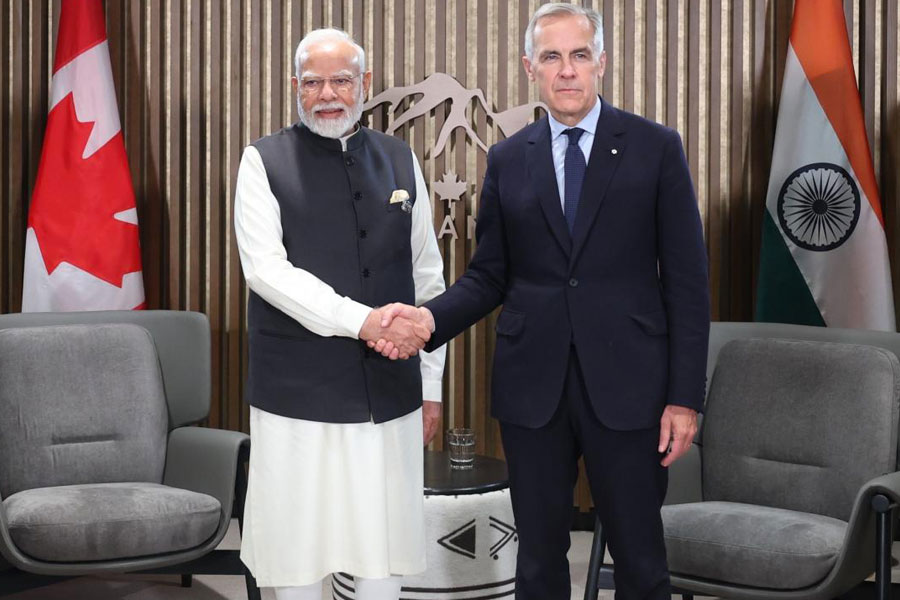
Indian Prime Minister Narendra Modi delivered a forceful address at the G7 Outreach Session in Canada, challenging global leaders to abandon double standards on terrorism, prioritize the needs of the Global South, and ensure artificial intelligence serves humanity rather than power. Speaking on the 50th anniversary of the G7, Modi framed India’s development model as a blueprint for equitable progress and global cooperation.
He opened by highlighting India’s achievements in energy access and sustainability, noting that nearly every household in the country now has electricity and that India maintains one of the lowest per-unit electricity costs globally. Despite being the fastest-growing major economy, India has already met its Paris climate commitments and is on track to achieve net-zero emissions by 2070. Renewable energy now accounts for about 50 percent of India’s installed capacity, with a target of 500 gigawatts by 2030. Modi emphasized India’s leadership in green initiatives, citing the International Solar Alliance, Global Biofuels Alliance, and Mission LiFE as examples of its commitment to a sustainable future.
He warned that the Global South continues to bear the brunt of global instability, from food and fuel shortages to financial and manufacturing disruptions. Modi criticized the selective application of international norms, stating that as long as double standards persist, inclusive development will remain out of reach. He reiterated India’s role as a voice for the Global South, asserting that the country would continue to bring their concerns to the global stage.
Modi’s most pointed remarks came on the issue of terrorism. Referring to the April 22 terrorist attack in Pahalgam, which he described as an assault on India’s soul and on all humanity, Modi condemned the global community’s inconsistent response to terrorism. He questioned whether the world would only act when terror reached their own doorsteps and challenged the legitimacy of rewarding nations that openly support terrorism while sanctioning others for lesser offenses. He warned that history would not forgive those who turn a blind eye to terrorism for the sake of vested interests.
On artificial intelligence, Modi acknowledged its transformative potential but cautioned that AI is energy-intensive and must be powered by renewable sources to be sustainable. He called for international governance frameworks that balance innovation with ethical safeguards. Modi proposed mandatory watermarking or disclosure of AI-generated content to combat the threat of deepfakes and societal disruption.
He spotlighted India’s human-centric approach to technology, citing the AI-based language platform BHASHINI and digital public infrastructure that empowers even the most remote citizens. Modi argued that India’s linguistic and cultural diversity makes it a valuable testing ground for inclusive AI models and offered India’s talent pool and democratic values as assets to global AI development.
Concluding his remarks, Modi invited G7 leaders to the AI Impact Summit in India next year and urged them to move from competition to cooperation in technology and energy. He closed with India’s guiding principle: “Sabka Saath, Sabka Vikas, Sabka Vishwas, aur Sabka Prayas”—People, Planet, and Progress. His speech marked a bold assertion of India’s global role and a challenge to the G7 to match rhetoric with resolve.