
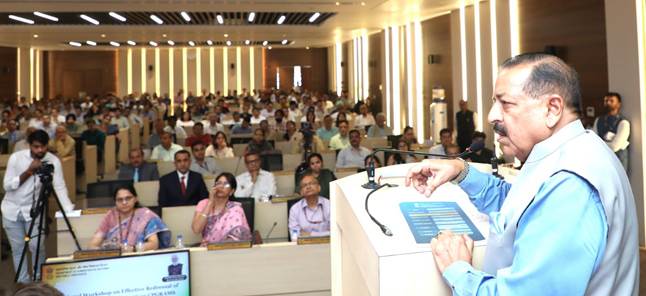
Union Minister Jitendra Singh has called for a paradigm shift in the handling of public grievances, asserting that grievance redressal must evolve from a mere administrative task to a mechanism for ensuring citizen satisfaction and systemic reform. Addressing the National Workshop on “Effective Redressal of Public Grievances, NextGen CPGRAMS and Progress Review” at the Indian Institute of Public Administration, Singh urged officials to treat grievances as opportunities to improve governance and enhance ease of living.
The Minister highlighted that between 2014 and 2025, the annual volume of public grievances rose dramatically from 200,000 to 2.6 million, underscoring a significant increase in public engagement and trust in government institutions. He attributed this transformation to the government’s citizen-centric digital governance initiatives under Prime Minister Narendra Modi’s leadership.
Singh described grievance redressal as central to the Prime Minister’s vision of “Maximum Governance, Minimum Government,” and stressed the need for accountability, transparency and timely feedback. Reflecting on personal interventions, he shared that he and senior officials regularly made unscheduled calls to complainants on Friday evenings to assess whether the resolution had truly met their expectations, noting that the goal was to reconnect with citizens who had become alienated from the system.
Among the workshop’s key highlights was the introduction of a human interface after grievance disposal, where trained personnel engage with complainants to evaluate satisfaction. Singh emphasised that repeated complaints on similar issues from different regions should trigger a review of existing rules and administrative frameworks. He cited the scrapping of over 1,600 outdated rules as part of this broader systemic overhaul.
Secretary of the Department of Administrative Reforms and Public Grievances, V. Srinivas, provided a progress overview of the revamped CPGRAMS platform. He reported that grievance redressal time has been reduced to 15 days and that citizen satisfaction has reached 62 percent. Between 2019 and 2025, more than 11.5 million grievances were redressed. The platform is now fully integrated with all Central Ministries, State Governments and 23 Administrative Training Institutes. It has also received international recognition from the Commonwealth Secretariat and the IBM Centre for Excellence.
Singh underscored that governance must foster a system where citizens can seek happiness without infringing on the rights of others. He reiterated that the role of public service delivery is to create such enabling conditions, affirming that governance should ensure this space exists without having to define happiness itself.
The Minister also acknowledged global interest in India’s grievance redressal ecosystem. He noted that delegations from Bangladesh, Maldives and South Africa have visited to study CPGRAMS and associated systems such as the Digital Life Certificate platform. He advocated more frequent deliberations beyond the annual workshop format, suggesting the use of expanded digital infrastructure for continuous engagement.
The workshop, held in the T N Chaturvedi Hall at the Indian Institute of Public Administration, was attended by Secretaries, Chief Secretaries, administrative training heads and grievance officers from across India. Organised by the Department of Administrative Reforms and Public Grievances, the event reflected a renewed emphasis on data-driven, citizen-first governance.
Among the key dignitaries present were K. Padmanabhaiah, Chairman of the Administrative Staff College of India; Avanish Kumar, Dean of the School of Public Policy and Governance; and senior officials from both Central Ministries and State Governments.