

The Telecom Regulatory Authority of India (TRAI) has released the “Indian Telecom Services Yearly Performance Indicators” report for 2024–25, outlining key metrics across telecom, cable TV, DTH and radio broadcasting. The report, based on service provider data, reflects strong financial growth, increased broadband penetration, evolving usage patterns, and infrastructure shifts in both urban and rural landscapes.
Total telecom subscribers in India reached 1.2008 billion, up from 1.19928 billion the previous year, registering a modest growth rate of 0.13 percent. Urban subscribers increased to 666.11 million while rural subscribers rose to 534.69 million. However, overall tele-density declined from 85.69 percent to 85.04 percent. Urban tele-density dipped from 133.72 percent to 131.45 percent, and rural tele-density slightly declined from 59.19 percent to 59.06 percent.
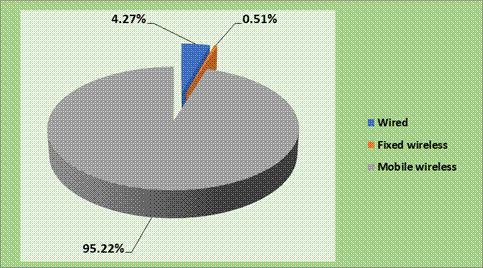
Internet subscribers rose from 954.4 million to 969.1 million, a growth rate of 1.54 percent. Of these, 944.12 million were broadband users, up 2.17 percent from 924.07 million, while narrowband subscribers declined by 17.66 percent to 24.98 million. Mobile wireless accounted for 95.22 percent of internet subscriptions, with fixed wireless and wired connections making up 0.51 percent and 4.27 percent, respectively.
Wireless data subscribers rose from 913.34 million to 939.51 million, a 2.87 percent increase. Total data usage surged by 17.46 percent to 228,779 petabytes. Revenue from wireless data usage climbed to ₹2.15078 trillion, reflecting a 15.49 percent annual growth. The average revenue per user (ARPU) for wireless services rose sharply by 16.89 percent to ₹174.46 per month. Prepaid ARPU grew from ₹146.37 to ₹173.84, while postpaid ARPU fell from ₹184.63 to ₹180.86.
Monthly average minutes of usage (MoUs) per subscriber rose from 963 to 1,000. MoUs for prepaid services increased from 997 to 1,047, whereas postpaid MoUs declined from 544 to 503.
Wireless (mobile and 5G Fixed Wireless Access) subscribers stood at 1.16376 billion, down slightly from 1.16549 billion, marking a 0.15 percent decline. Mobile-only subscribers dropped to 1.15699 billion, registering a 0.73 percent contraction and a net loss of 8.5 million. Wireless tele-density declined to 82.42 percent overall, with rural and urban figures at 58.67 percent and 124.83 percent, respectively.
In contrast, the wireline segment saw a resurgence, growing from 33.79 million to 37.04 million subscribers, a 9.62 percent increase. Urban subscribers accounted for 33.54 million, while rural subscribers reached 3.5 million. Overall wireline tele-density rose to 2.62 percent. Rural and urban wireline tele-densities climbed to 0.39 percent and 6.62 percent, respectively.
Gross Revenue (GR) from telecom services rose 10.72 percent to ₹3.72097 trillion. Applicable Gross Revenue (ApGR) increased 10.26 percent to ₹3.56283 trillion. Adjusted Gross Revenue (AGR) surged 12.02 percent to ₹3.03025 trillion. Pass-through charges declined by 1.31 percent to ₹528.79 billion, making up 14.21 percent of GR. Spectrum Usage Charges (SUC) rose 13.02 percent to ₹38.07 billion and license fees increased 12.02 percent to ₹242.42 billion.
Access services contributed 83.65 percent of total AGR. Within this category, GR, ApGR, and AGR rose by 13.77 percent, 12.88 percent, and 15.52 percent, respectively. SUC and license fees for access services increased by 13.11 percent and 15.57 percent, respectively, while pass-through charges declined by 1.98 percent.
In broadcasting, India had 918 private satellite TV channels permitted by the Ministry of Information and Broadcasting as of 31 March 2025. Of these, 908 were available for downlinking and 333 were designated as pay TV channels—232 in standard definition and 101 in high definition.
Pay DTH services, operated by four private providers, had an active subscriber base of 56.92 million, down from 61.97 million. This excludes subscribers of Doordarshan’s free DTH services.
Private FM radio broadcasting saw consolidation. Six channels operated by three digital radio firms were merged with South Asia FM Ltd, keeping the total number of private FM radio stations unchanged at 388 across 113 cities, now operated by 33 entities. Community radio stations grew from 494 to 531 during the reporting year.
The report noted 67,023 public mobile radio trunk services and 243,663 very small aperture terminals (VSATs) operating nationwide. India had 10,185 public call offices (PCOs) at year-end.
Urban-rural divides remained evident across parameters, with rural areas accounting for 44.53 percent of total subscriptions. Private operators continued to dominate, with 91.47 percent market share overall, including 92.09 percent in wireless and 72.13 percent in wireline. Public sector operators held 8.53 percent overall, 7.91 percent in wireless and 27.87 percent in wireline.
The report concluded that although mobile subscriber growth was flat, India’s telecom sector remains financially robust and data-intensive, with wireless ARPU and internet usage rising sharply. Wireline revival and broadband expansion signal growing infrastructure depth, while reforms and consolidation are reshaping the broadcasting landscape.