
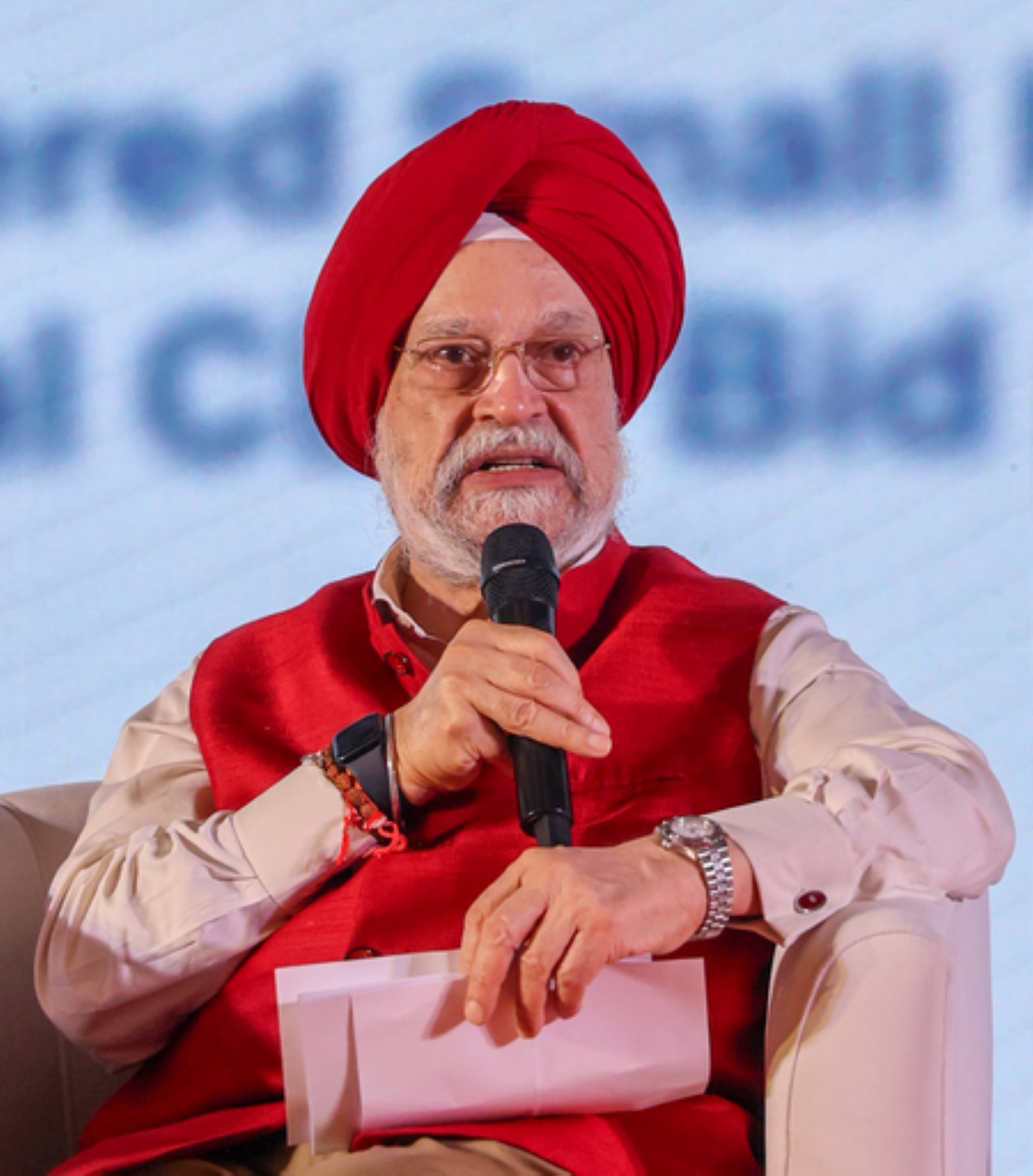
India is making steady and confident progress towards oil self-sufficiency, according to Petroleum Minister Hardeep Singh Puri, who stated that under Prime Minister Narendra Modi’s leadership, the nation is securing its energy future “step by step.” Puri emphasized that India’s oil and gas landscape is undergoing a major transformation with new policy reforms, expanded exploration zones, and technological integration.
One of the most significant developments is the opening of 1 million square kilometers of offshore territory for oilfield exploration, with 99 percent of previously declared ‘No-Go’ areas now cleared for commercial and scientific activity. The Open Acreage Licensing Programme (OALP) has become the focal point for attracting global and domestic energy investment, with Round X poised to set new benchmarks in participation and capital flow.
The Minister detailed ongoing activity under OALP-X, which includes 25 offered blocks and a total of 154 active exploration blocks across the country. The sector has recently recorded 14 new oil and gas discoveries, with Rs 792 crore invested through Mission Anveshan to enhance exploration analytics and project deployment. Over 6,200 GLKM of seismic data has already been collected, reinforcing India’s subsurface mapping capabilities. ONGC alone is producing 34,000 barrels of oil per day (BOPD) and 3 million metric standard cubic meters per day (MMSCMD) of natural gas, illustrating early outcomes from deeper and broader prospecting efforts.
In a move to fast-track legal and institutional clarity, the Petroleum Ministry recently invited public feedback on a revised set of draft rules—the Petroleum and Natural Gas Rules, Model Revenue Sharing Contract and Petroleum Lease agreement. These documents represent a reimagining of exploration governance designed to facilitate faster approvals, transparent profit-sharing and investor-friendly terms.
The Oilfields (Regulation and Development) Act of 1948 was amended in March 2025, and the PNG Rules have followed within three months, in preparation for what is being described as the world’s largest bidding round for oil and gas exploration. Puri stated that the reform push reflects Prime Minister Modi’s vision to establish India as an energy powerhouse rooted in regulatory agility and investment appeal.
He urged entrepreneurs and industry leaders to recognize the unprecedented opportunity now available in India’s oil and gas sector. “It has never been easier, faster, or more profitable to invest in India’s energy future,” said Puri, noting that both infrastructure readiness and policy alignment are converging to create favorable investment conditions.
On the distribution and access front, Puri pointed to a transformation in India’s clean cooking fuel landscape. City gas distribution coverage has expanded from 55 cities in 2014 to over 300 cities and towns in 2025. The number of Indian kitchens now using piped natural gas (PNG) has grown from 2.5 million to 15 million, reflecting near-total geographic and population coverage. Puri described the shift as a “revolution” catalyzed under Prime Minister Modi’s leadership, with tangible impacts on household health, energy equity and urban service delivery.
Taken together, these developments indicate that India is not merely expanding its exploration grid but redefining its entire upstream and downstream oil ecosystem—from policy and law to field operations and consumer access. The government’s multi-pronged strategy underscores a deeper ambition: to establish sovereign energy resilience while projecting confidence in global investor circles.
The nation’s steady pursuit of oil self-sufficiency marks not just an economic milestone but a strategic evolution in India’s long-term energy calculus.