
India has positioned itself as a global leader in tackling anemia, a condition affecting millions of children, women, and adolescents across the country. With nearly 67.1 percent of children and 59.1 percent of adolescent girls reportedly anemic according to the National Family Health Survey (NFHS-5), the Government of India has escalated its public health response through innovative and comprehensive interventions. The condition, primarily caused by iron deficiency, reflects broader challenges of poor nutrition, maternal health deficits, and limited access to fortified and iron-rich foods.
Recognizing anemia’s far-reaching consequences—ranging from impaired cognitive development in children to severe complications in pregnancy—the government has implemented a series of national strategies aimed at disrupting the intergenerational cycle of malnutrition. Under the flagship program Anemia Mukt Bharat (AMB), launched in 2018, India has rolled out targeted measures aligned with a 6x6x6 strategy: six key interventions for six targeted population groups, supported by six institutional mechanisms. These efforts have converged with other landmark initiatives, including POSHAN Abhiyaan and the School Health Program, ensuring that the fight against anemia becomes a nationwide, community-driven endeavor.
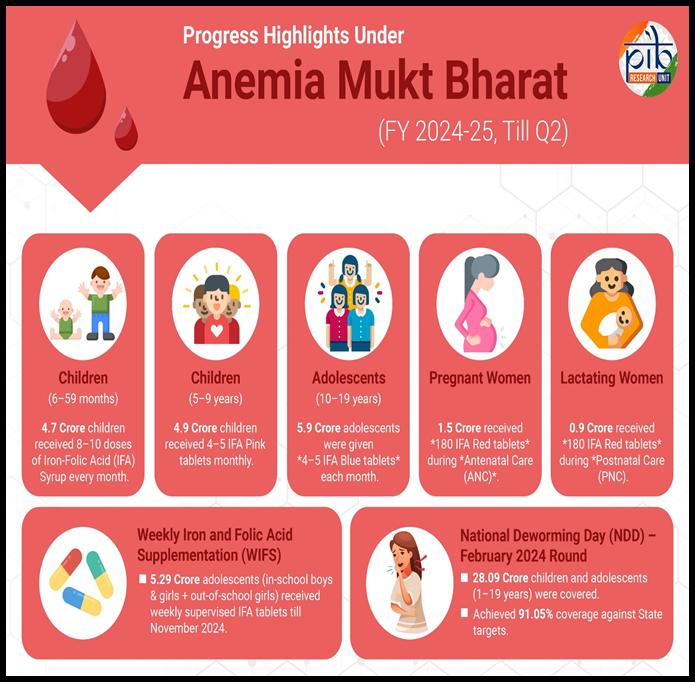
The AMB strategy emphasizes Iron and Folic Acid (IFA) supplementation tailored to specific age groups and physiological needs, biannual deworming campaigns, fortified food distribution, and behavioral change communication. Children between six months and five years receive biweekly iron syrup, while older children aged five to ten are provided weekly supplements. Adolescents, as well as reproductive-aged women, follow a regimen of weekly tablets, while pregnant and lactating women receive additional nutritional support during antenatal and postnatal care. The program also integrates advanced digital tools for real-time monitoring of anemia screening, treatment coverage, and supply logistics, ensuring greater accountability and improved outcomes.
India’s government has prioritized accessibility to fortified foods, distributing nutrient-enriched rice through welfare programs such as the Targeted Public Distribution System (TPDS) and the Integrated Child Development Services (ICDS). To further encourage dietary improvements, state-level outreach programs like Village Health and Nutrition Days focus on locally available resources to increase the intake of iron-rich foods. Addressing non-nutritional causes of anemia, such as malaria and fluorosis, has also emerged as a critical component of the country’s efforts.
The impact of these initiatives is reflected in the staggering scale of the government’s reach. In the second quarter of the fiscal year 2024–25 alone, 154 million children and adolescents received Iron and Folic Acid supplements. By November 2024, the National Deworming Day campaign had covered approximately 280.9 million children and adolescents, achieving an impressive 91 percent of state-level targets. These figures highlight the transformative potential of sustained investment in public health innovation and last-mile delivery.
India’s approach to anemia eradication integrates maternal and child health services with adolescent nutrition. Programs such as the Weekly Iron and Folic Acid Supplementation (WIFS) scheme and school-based awareness drives aim to empower young people with knowledge about the importance of nutrition and lifestyle changes. Pregnant women benefit from maternity-focused initiatives such as the Pradhan Mantri Surakshit Matritva Abhiyan, which provides free antenatal screenings, including anemia testing, on designated days each month. These efforts are further supported by enhanced healthcare infrastructure, including functional blood storage units and high-dependency obstetric facilities in underserved areas.
Globally, anemia affects an estimated 500 million women aged 15 to 49 years and 269 million children under five, underscoring its status as a widespread and urgent health challenge. In India, however, the prevalence remains particularly acute, with 57 percent of women of reproductive age, 67 percent of children, and over half of all pregnant women grappling with the condition. Recognizing the socioeconomic and developmental costs associated with anemia, the Indian government has embraced a life-cycle approach to mitigate its effects, establishing inter-ministerial coordination and fostering collaborations with research institutions such as the Indian Council of Medical Research (ICMR). These efforts aim to generate scalable interventions for anemia control and inform evidence-based policies.
Despite the magnitude of the challenge, India’s holistic public health interventions offer hope for millions. By prioritizing gender-sensitive approaches and integrating digital innovations, the government is not only addressing the immediate nutritional needs of vulnerable populations but also building resilient systems capable of preventing anemia in the long term. The success of Anemia Mukt Bharat stands as a testament to India’s commitment to equitable and inclusive healthcare, demonstrating that with sustained focus and resources, a future free from anemia is achievable.