
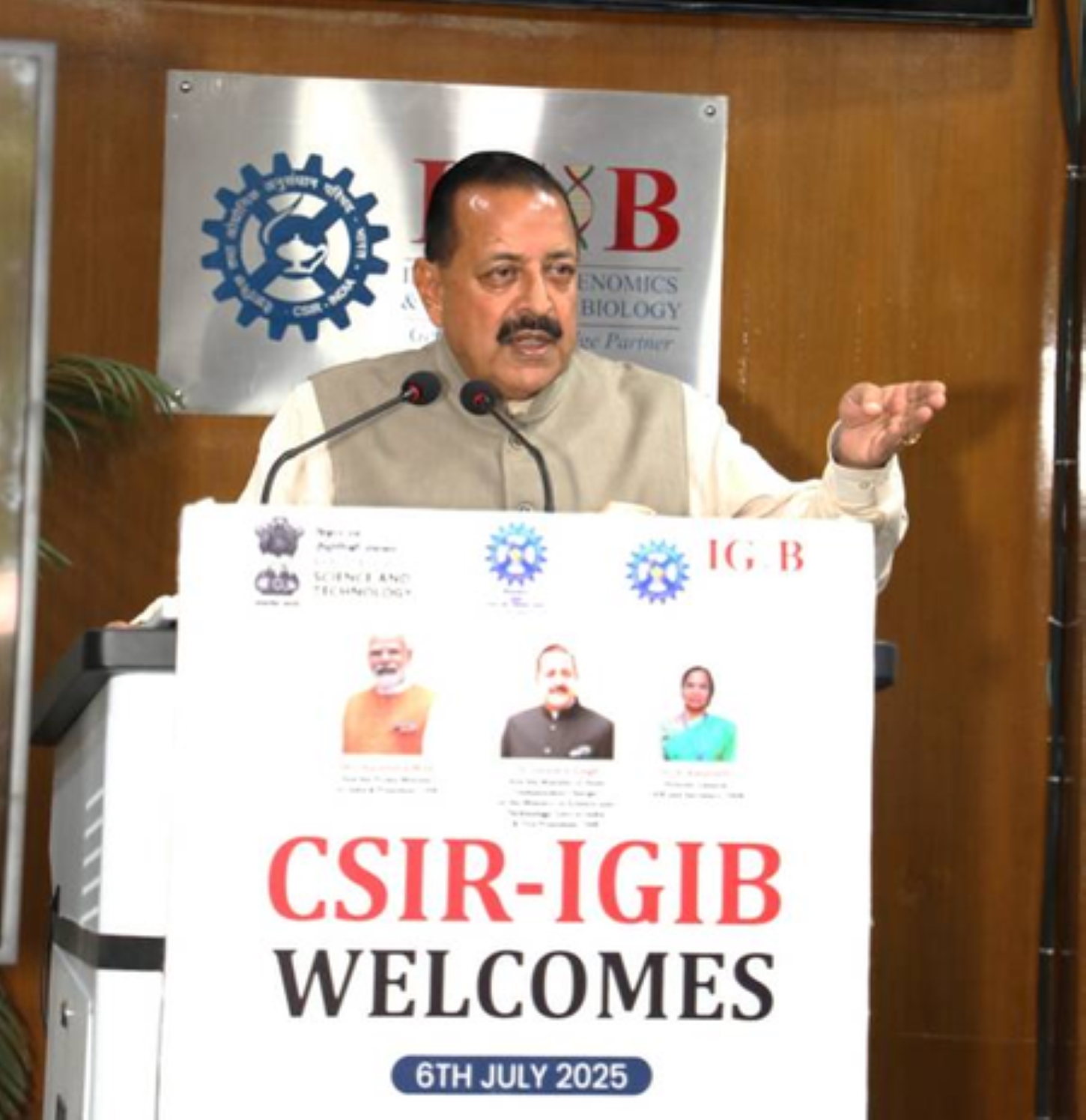
India has taken a decisive step toward revolutionising healthcare by launching the Phenome India “National Biobank” at the CSIR-Institute of Genomics and Integrative Biology (IGIB) in New Delhi. Inaugurated by Union Minister of State for Science and Technology Jitendra Singh, the state-of-the-art facility will serve as a foundational national resource for personalised medicine, data-driven research, and genomics-based public health strategies.
The National Biobank is designed to collect detailed genomic, clinical, and lifestyle data from a demographically diverse cohort of 10,000 individuals across India. Inspired by the UK Biobank model but uniquely adapted for India’s geographical, ethnic, and socio-economic diversity, it marks a transformative step in building a longitudinal health database tailored to the Indian population.
Jitendra Singh stated that the initiative represents a shift from theoretical aspiration to practical implementation of personalised healthcare, where treatment protocols may soon be tailored to an individual’s genetic profile, environment, and behaviour. He cited prior studies on central obesity among Indians to demonstrate the need for population-specific data—where lean individuals may still carry high-risk abdominal fat not easily detected through conventional diagnostics.
The Biobank is positioned to play a pivotal role in early diagnosis and targeted treatment of complex diseases such as cancer, diabetes, cardiovascular illness, and rare genetic disorders. It will enable the development of AI-powered diagnostics and gene-guided therapies, especially suited for India’s heterogeneous and complex health landscape.
Singh commended India’s broader scientific progress, referencing strides in quantum research, CRISPR-based genome editing, and antimicrobial resistance. He emphasised that India has graduated from being a follower in global science to becoming an early adopter—if not a frontrunner—in many frontier domains. He also encouraged integration between the Biobank and parallel national efforts in biotechnology, pharmaceutical research, and computational medicine.
Director General of CSIR and Secretary of DSIR, N. Kalaiselvi, praised the Biobank as a bold and visionary act of scientific nation-building. She said the facility reflects India’s determination to create its own world-class health data repository that is not reliant on borrowed models from abroad.
The minister further called for stronger collaborations between research institutions, government departments, and industry stakeholders. He underscored the need for translational research that goes beyond academic publication and brings tangible solutions to market and society.
The Biobank is expected to become a key enabler in India’s path to healthcare self-reliance. It promises to underpin future breakthroughs in predictive medicine, therapeutic targeting, and public health policy—making individualised care a mainstream reality for Indian citizens.