
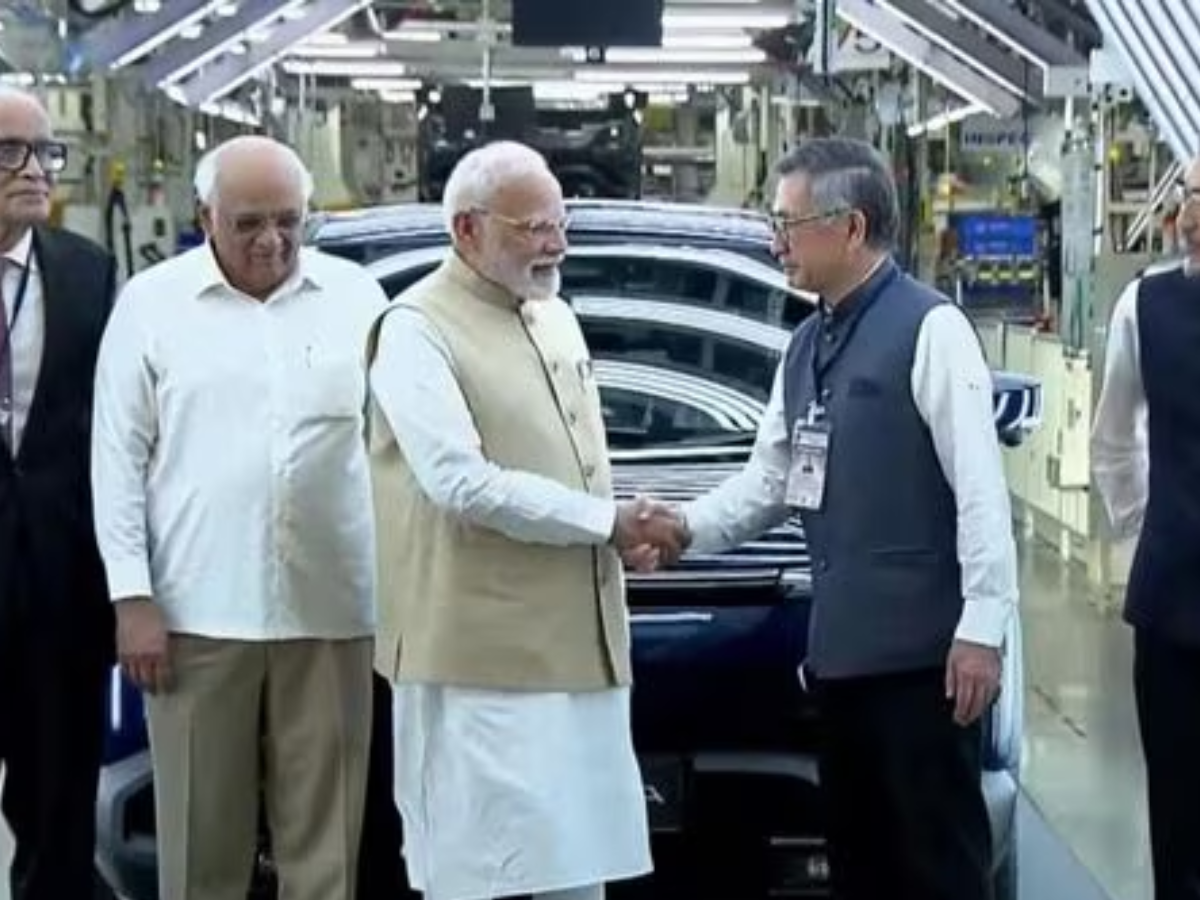
India has inaugurated a major green mobility initiative at Hansalpur, Gujarat, marking the start of electric vehicle exports to 100 countries and the launch of hybrid battery electrode manufacturing. The event, attended by Prime Minister Narendra Modi, Suzuki Motor Corporation President Toshihiro Suzuki, and Japanese Ambassador Keiichi Ono, celebrates a new phase in India’s Make in India journey and deepens the Bharat-Japan industrial partnership.
Maruti Suzuki, now entering its thirteenth year in Gujarat, will lead the export of Made-in-India EVs globally. The Hansalpur plant will also begin local production of battery cell electrodes, a first for India, under a joint initiative by three Japanese companies. This localisation is expected to strengthen India’s self-reliance and accelerate hybrid EV growth.
The Prime Minister unveiled a prototype hybrid ambulance developed by Maruti Suzuki in just six months, aligning with the Rs 11,000 crore PM E-DRIVE scheme, which includes dedicated funding for e-ambulances. He emphasised that EVs are not just alternatives but solutions to pollution and supply chain challenges.
India’s EV ecosystem has evolved rapidly, with the TDSG battery plant laid in 2017 now producing critical components domestically. The Prime Minister highlighted that Suzuki Japan is exporting cars made in India back to Japan, showcasing the trust global companies place in Indian manufacturing.
Over the past decade, electronics production has surged nearly 500 percent, mobile phone manufacturing by 2,700 percent, and defence production by over 200 percent. These gains reflect the success of reforms, industrial corridors, logistics parks, and Production Linked Incentives.
The Prime Minister urged all Indian states to compete in reforms and investor-friendly policies, stressing that proactive governance will attract global investment. He recalled the early days of the Vibrant Gujarat Summit and the cultural sensitivity shown to Japanese investors, including Japanese-language materials and cuisine.
India is also advancing in semiconductor manufacturing, with six plants nearing completion and four new units approved in Odisha, Punjab, and Andhra Pradesh. Under the National Critical Mineral Mission, over 1,200 exploration expeditions will be launched to secure rare earth supplies.
The Prime Minister reaffirmed that the Bharat-Japan partnership is “made for each other,” rooted in trust and shared progress. He called on citizens to embrace Swadeshi, defining it as production powered by Indian labour, regardless of investment origin. With this spirit, India aims to build a Viksit Bharat by 2047, contributing to global welfare through clean energy, innovation, and inclusive development.