

India has successfully concluded a comprehensive Free Trade Agreement with the United Kingdom, resulting in the complete removal of tariffs on 97.1% of Indian tariff lines. The move marks one of the most sweeping trade liberalizations India has undertaken with a G7 economy, promising direct gains for Indian industries across agriculture, manufacturing, and value-added sectors.
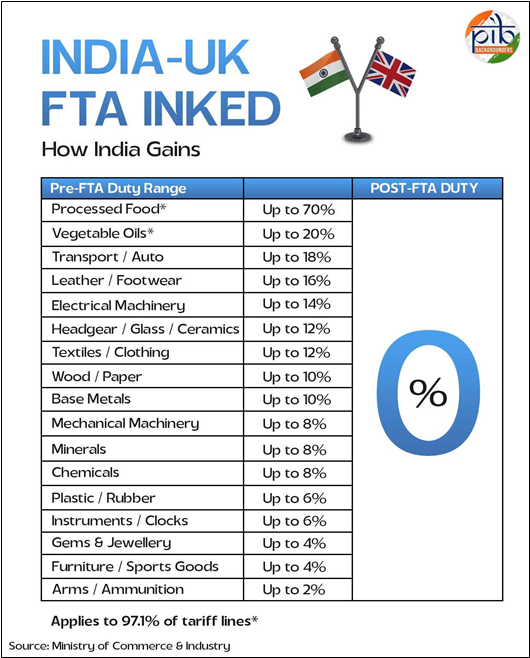
According to data from the Ministry of Commerce and Industry, the pre-FTA tariff landscape in the UK was a substantial barrier to Indian exporters. Some Indian products faced import duties as high as 70%, notably in the processed food category. Under the FTA, this burden has been eliminated entirely. The agreement reduces post-FTA import duties on these goods to zero, leveling the playing field for Indian businesses in one of the world’s most lucrative consumer markets.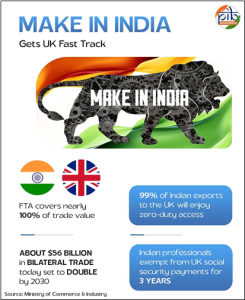
Vegetable oils, another important Indian export commodity, previously attracted tariffs up to 20%. These have now also been reduced to zero. Indian transport and automobile exports, which were subject to UK tariffs of up to 18%, will benefit similarly. This will allow India’s growing automotive sector—particularly EV components and small car exports—to aggressively enter UK supply chains.
The leather and footwear industry, long a pillar of India’s labor-intensive export economy, faced tariffs up to 16%. The new agreement removes all such barriers, potentially boosting job creation across thousands of units employing skilled and semi-skilled workers.
Sectors dependent on capital goods and value-added engineering—such as electrical and mechanical machinery—faced duties up to 14% and 8%, respectively. With all these tariffs now set to zero, India’s high-quality manufacturing ecosystem can scale competitively against traditional European players. Instruments and clocks, which earlier faced 6% duty, are similarly zeroed out, providing a leg up to Indian precision engineering exporters.
Indian artisans and MSMEs will gain from zero tariffs on headgear, glass, and ceramics—categories previously taxed up to 12%—allowing wider reach of India’s handmade and semi-industrial products in the UK. Textiles and clothing, a historically significant segment for Indian trade, are no longer subject to UK duties that previously reached 12%.
India’s wood and paper exports, formerly taxed up to 10%, and base metals with similar duty levels, are also included in the duty elimination. The chemicals and minerals sector—facing up to 8% duties—now stands to benefit not just from better access but greater cost competitiveness for intermediates and specialty products.
The FTA further slashes tariffs on plastics and rubber, arms and ammunition, and sports goods—previously taxed up to 6%, 2%, and 4%, respectively. Furniture exports also gain from complete duty removal.
Gems and jewellery, one of India’s highest value and most employment-intensive export segments, is among the biggest gainers. These products faced UK import duties up to 4% prior to the FTA. Now, Indian exporters—especially from cities like Surat and Jaipur—can expect stronger demand as Indian jewellery becomes more price-competitive.
The benefits extend to agricultural and food-based sectors, with processed foods and vegetable oils among the most protected categories in the UK before the FTA. The elimination of tariffs—up to 70% in some cases—will unlock significant growth for India’s agro-processing sector, especially in segments like ready-to-eat meals, organic products, and shelf-stable goods.
The government emphasized that this sweeping tariff elimination applies to 97.1% of the UK’s tariff lines on Indian goods, and the impact is immediate. The FTA marks a milestone in India’s trade diplomacy, as it not only secures economic access but also affirms India’s status as a trusted trade partner amidst shifting global alignments.
The Ministry of Commerce and Industry has clarified that this agreement does not merely provide market access—it resets the baseline for Indian exports. With the UK being a high-income, consumption-driven market with strong Indian diaspora ties, Indian products now enjoy structural tariff parity with goods from long-standing UK trade partners.
In rupee terms, the benefits could run into hundreds of billions annually across sectors, as the duty-free access helps Indian exporters capture higher market share, increase volumes, and tap premium pricing.
The agreement also paves the way for deeper cooperation in services, standards alignment, and supply chain resilience. While tariff removal covers goods trade, negotiators are expected to build upon this breakthrough for future collaboration in services, education, and sustainability.
The FTA’s design reflects India’s evolving trade strategy: protecting domestic vulnerabilities while ensuring aggressive global integration for competitive sectors. The government has positioned this as a win not just for exporters, but also for workers, MSMEs, and India’s long-term manufacturing ambition under the Make in India banner.
With this agreement, India not only secures zero-duty access in the post-Brexit UK market, but sets a precedent for future FTAs with other advanced economies. The United Kingdom, for its part, gains access to a trusted, fast-growing supply hub in the Indo-Pacific, anchored by shared democratic values and economic interests.
The India-UK FTA thus signals the rise of a new trade architecture—balanced, ambitious, and beneficial to both sides.