
India is steering towards a dynamic new era in cruise tourism, backed by extensive infrastructure, policy reforms, and strategic vision. With a 7,500-kilometre coastline, 12 major ports, 200 minor ports, and over 20,000 kilometres of navigable waterways crisscrossing more than 400 rivers, the country is uniquely positioned to become a global hub for both coastal and river cruise tourism. The launch of the Cruise Bharat Mission in September 2024 has marked a significant milestone in this effort, targeting a doubling of cruise passenger traffic by 2029.
In the financial year 2023–24, cruise tourism in India recorded 471,000 passengers. Through the Cruise Bharat Mission, this number is expected to rise sharply, with projections of over 1.5 million river cruise passengers traversing more than 5,000 kilometres of operational waterways. The mission integrates a whole-of-government approach involving Customs, Immigration, CISF, state tourism departments, maritime boards, district administrations, and police forces to streamline policy, regulatory, and operational aspects.
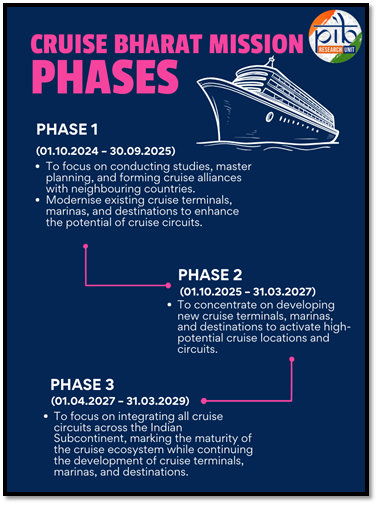
The Cruise Bharat Mission is being executed in three phases, beginning from 1 October 2024 and running through to 31 March 2029. It envisions making India a leading global cruise destination by providing seamless experiences across riverine and oceanic routes, with infrastructure development and regulatory support forming its backbone.
Under the broader framework of Maritime India Vision 2030, India aims to increase its cruise market eightfold over the next decade. Interventions span oceanic and coastal cruises, island and terminal infrastructure, and river and inland cruise development. Measures to incentivize cruise liners include berthing priority over cargo ships, standardized and discounted port charges, waiver of ousting charges, and cabotage exemptions allowing foreign cruise ships to carry Indian passengers between domestic ports. Other enablers include visa-on-arrival and e-visa extensions, a uniform standard operating procedure for cruise operations, and a single e-Landing Card accepted across all ports on an itinerary.
River cruise tourism has emerged as a key growth segment. National Waterways rich in ecological and cultural diversity are being developed with navigational channels, aids, dredging operations, and vessel berthing facilities. Heritage sites and local attractions along the banks of rivers such as the Ganga, Brahmaputra, and backwaters of Alappuzha are being promoted to enhance the travel experience. Notably, the MV Ganga Vilas—launched in January 2023—undertook the world’s longest river cruise from Varanasi to Dibrugarh, covering 3,200 kilometres through 27 river systems in five Indian states and Bangladesh. This historic voyage earned a place in the Limca Book of Records.
The Inland Waterways Authority of India (IWAI) has entered into a series of agreements to develop eco-friendly cruise routes. In March 2025, IWAI signed a memorandum of understanding with Delhi government agencies to convert a four-kilometre stretch of the Yamuna between Sonia Vihar and Jagatpur into a hub for sustainable cruise tourism. This project includes deployment of electric-solar hybrid boats, installation of two HDPE jetties, and incorporation of bio-toilets and safety features.
A separate MoU was signed with the Jammu and Kashmir government to develop river cruise tourism on three designated National Waterways: the Chenab, Jhelum, and Ravi. IWAI has committed 10 billion rupees toward cruise tourism infrastructure in this region. Another agreement with Gujarat and Madhya Pradesh facilitated cruise operations from Kukshi to the Sardar Sarovar Dam starting April 2024.
To promote stakeholder engagement, IWAI organized river cruise conferences in Kolkata, Kochi, and Delhi between March and May 2024. These forums laid the groundwork for collaborative efforts among operators, tourism boards, and port authorities. A landmark development was the first Inland Waterways Development Council meeting aboard the vessel “Ganges Queen” in Kolkata. The council committed 450 billion rupees in investments to boost river cruise tourism by 2047—350 billion rupees earmarked for cruise vessels and 100 billion rupees for terminal infrastructure.
The River Cruise Tourism Roadmap 2047 was also launched at this meeting, outlining a development strategy across four pillars—Infrastructure, Integration, Accessibility, and Policy. The roadmap identifies more than 30 inland routes and tourist circuits for phased expansion, further integrating river cruises into the national tourism ecosystem.
Cruise tourism in India is poised to deliver both economic and social dividends. It is expected to generate employment in the hospitality, culture, entertainment, and service sectors while contributing to local economies through tourism-related spending. With investments in electric-hybrid propulsion, green infrastructure, and digital onboarding solutions, India is also aligning cruise tourism with sustainability goals.
As India continues to enhance its riverine and coastal infrastructure, simplify regulatory norms, and promote cultural tourism, it is charting a new course that positions cruise tourism as a key driver of economic growth and global engagement. From Kerala’s serene backwaters to the sacred expanse of the Ganga and the historic stretches of the Yamuna, cruise tourism is unlocking the hidden potential of Bharat’s waterways and inviting travelers from around the world to rediscover the country from its rivers and coasts.