

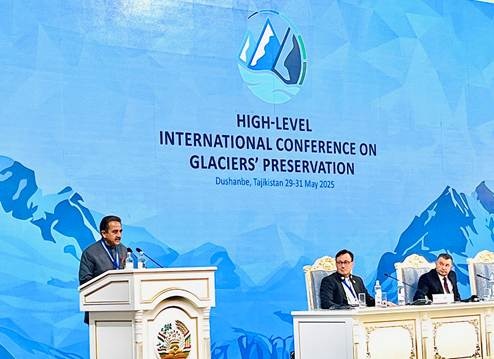
India reaffirmed its commitment to glacier preservation and climate resilience at the High-Level International Conference on Glaciers’ Preservation in Dushanbe, Tajikistan. The event gathered policymakers, scientists, and ministers from around the world to discuss urgent actions needed to safeguard glaciers, which serve as critical freshwater reservoirs and indicators of climate change. Union Minister of State for Environment, Forest, and Climate Change Kirti Vardhan Singh addressed the plenary session, highlighting the immediate threat posed by glacial retreat and its far-reaching consequences for water security, biodiversity, and human livelihoods.
Singh emphasized that the Himalayan ecosystem, intrinsically linked to India’s climate security, is experiencing disproportionate impacts due to glacier melt. India has implemented significant strategic measures under the National Mission for Sustaining the Himalayan Ecosystem, a key component of the National Action Plan on Climate Change, to counteract these effects. The country has also established a Centre for Cryosphere and Climate Change Studies, advancing research and monitoring of glaciers and glacial lakes across the Indian Himalayan Region. Leveraging cutting-edge remote sensing and Geographic Information System technologies led by ISRO, India is systematically tracking changes in glacier mass, extent, and dynamics. Coordinated research by institutions such as the National Centre for Polar and Ocean Research, the National Institute of Hydrology, the Wadia Institute of Himalayan Geology, and the G.B. Pant National Institute of Himalayan Environment strengthens India’s understanding of glacier systems, supporting data-driven policy formulation for sustainable water management.
India has reinforced disaster preparedness in the Himalayan region by improving early warning systems and mapping risks associated with Glacial Lake Outburst Floods, initiatives coordinated by the National Disaster Management Authority. Singh stressed the importance of regional cooperation to enhance resilience, improve data-sharing frameworks, and foster coordinated responses to challenges faced by mountain ecosystems. He reiterated India’s global stance on climate equity, emphasizing the principle of Common but Differentiated Responsibilities and Respective Capabilities, particularly as South Asia remains highly vulnerable to climate change despite contributing minimally to global emissions.
Under Prime Minister Narendra Modi’s leadership, India continues to implement an ambitious and balanced climate strategy, achieving milestones that reflect its commitment to environmental stewardship. The country now sources nearly half of its installed electricity capacity from non-fossil fuels, has reduced the emission intensity of GDP by thirty-six percent since 2005, and has created an additional carbon sink through afforestation efforts, significantly aiding its sustainable development goals. Singh underscored that climate adaptation and mitigation must be context-specific, taking into account national circumstances, development priorities, and historical responsibilities.
Welcoming the designation of 2025 as the International Year of Glaciers’ Preservation and the Decade of Action for Cryospheric Sciences, Singh called for enhanced global cooperation, shared scientific research, and increased financial and technological support for developing countries. He reaffirmed India’s readiness to strengthen partnerships and contribute meaningfully to global efforts aimed at safeguarding glaciers and ensuring climate resilience in the years ahead. The conference underscored the urgency of addressing glacier preservation as a critical component of climate action, positioning India as a key advocate for sustainable environmental governance on the global stage.