
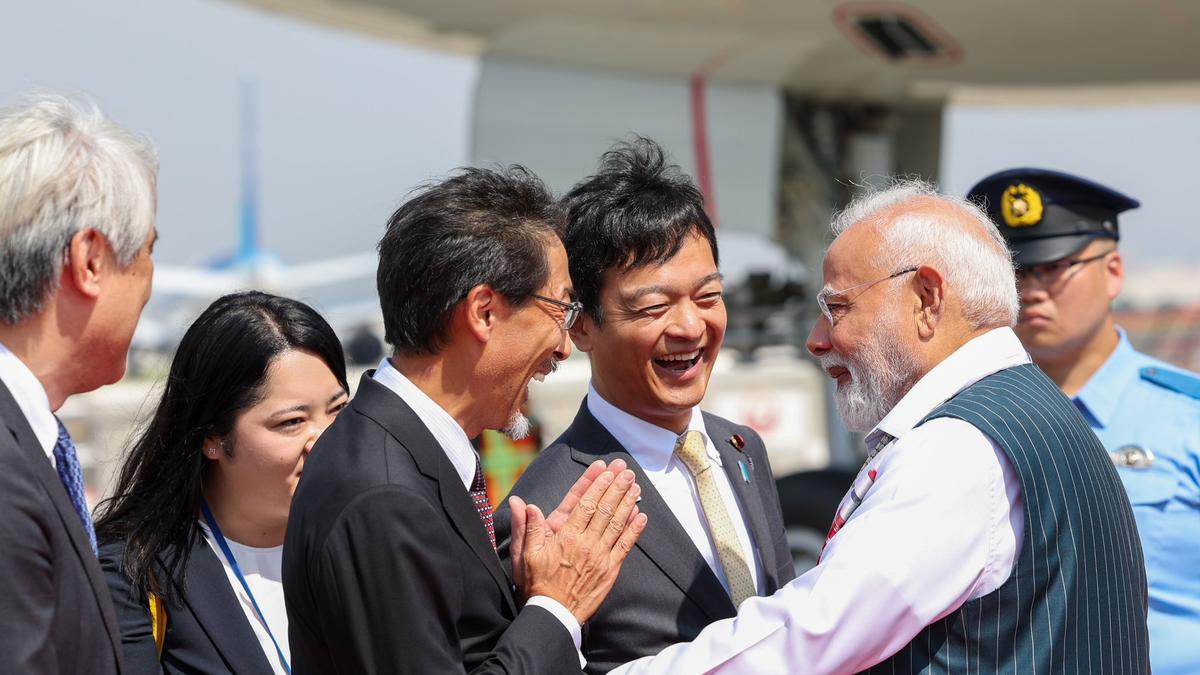
India and Japan have reaffirmed their deep-rooted civilizational ties and elevated their Special Strategic and Global Partnership during the 15th Annual Summit held in Tokyo. Prime Minister Modi and Prime Minister Ishiba Shigeru announced a series of landmark initiatives aimed at securing mutual prosperity and regional stability for future generations.
The summit produced three major documents: a Joint Vision for the Next Decade outlining eight pillars of cooperation including economy, mobility, environment, and innovation; a Joint Declaration on Security Cooperation to strengthen defence ties in light of evolving geopolitical realities; and an Action Plan for Human Resource Exchange targeting the movement of over 500,000 personnel between the two countries in five years.
The leaders launched the India-Japan Economic Security Initiative to bolster supply chain resilience and accelerate collaboration in critical sectors such as semiconductors, clean energy, pharmaceuticals, and critical minerals. A Memorandum of Cooperation on Mineral Resources was signed to expand business opportunities in strategic materials.
India-Japan Digital Partnership 2.0 was unveiled to deepen cooperation in emerging technologies, including artificial intelligence and data center development. A new AI Cooperation Initiative will support joint research, academic exchange, and platform creation. Prime Minister Modi invited Prime Minister Ishiba to attend the AI Impact Summit in India in February 2026.
Defence cooperation reached new heights with bilateral exercises across all three services in 2023, including Veer Guardian, MILAN, and Tarang Shakti. The leaders welcomed progress in defence equipment collaboration and urged expedited outcomes. Japan’s Maritime Self Defense Force and Air Self Defense Force have actively participated in Indian-hosted exercises, reinforcing operational synergy.
Economic ties were further strengthened with a new target of 10 trillion Yen in private investment from Japan to India. The leaders endorsed efforts to support Japan Industrial Townships and expand cooperation in logistics, food processing, MSMEs, and industrial capital goods. They agreed to accelerate the review of the Comprehensive Economic Partnership Agreement to make it more forward-looking.
The Mumbai-Ahmedabad High Speed Rail project was reaffirmed as a flagship initiative. India welcomed Japan’s offer to introduce the E10 Shinkansen series and agreed to commence work on installing Japanese signalling systems and inspection trains.
Clean energy cooperation was reinforced with the signing of agreements on hydrogen, ammonia, and the Joint Crediting Mechanism. The leaders emphasized multiple pathways to net-zero, tailored to national circumstances.
People-to-people ties were deepened with the opening of the Indian Consulate in Fukuoka and expansion of Japanese language education in India. The summit celebrated the success of tourism exchanges under the theme “Connecting Himalayas with Mount Fuji” and marked 2025 as the Year of Science, Technology and Innovation Exchange.
The leaders expressed concern over regional security issues including the East and South China Seas, North Korea’s missile activities, and the crisis in Myanmar. They condemned terrorism in all forms, including the attack in Pahalgam, and called for accountability of perpetrators and financiers.
India and Japan committed to collaborative development in Africa through the new Cooperation Initiative for Sustainable Economic Development and welcomed Japan’s Economic Region Initiative for Indian Ocean-Africa connectivity.
The summit concluded with a shared commitment to reform the UN Security Council, mutual support for permanent seats, and a pledge to celebrate the 75th anniversary of diplomatic relations in 2027 with vibrant exchanges across business, science, and culture. Prime Minister Ishiba accepted Prime Minister Modi’s invitation to attend the upcoming Quad Leaders’ Summit in India, reinforcing the enduring strength of the India-Japan partnership.