
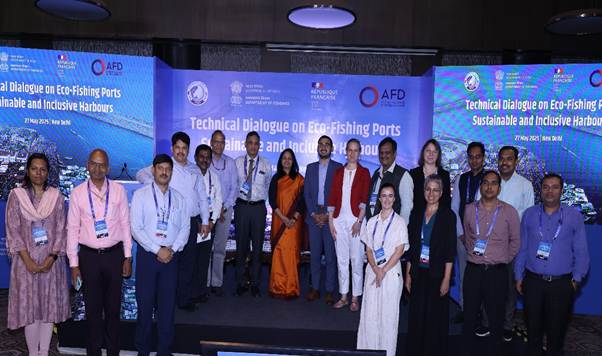
In a landmark collaboration, India’s Department of Fisheries under the Ministry of Fisheries, Animal Husbandry & Dairying (MoFAH&D) partnered with the Agence Française de Développement (AFD) to host a Technical Dialogue on Eco-Fishing Ports: Sustainable and Inclusive Harbours in New Delhi. The event marked a pivotal step in enhancing India’s fisheries infrastructure while focusing on reducing environmental impact, maximizing economic benefits, and fostering social inclusion.
Chaired by Neetu Kumari Prasad, Joint Secretary (Marine), Department of Fisheries, the dialogue saw participation from key stakeholders, including Lise Breuil, Country Director of AFD; Camille Severac, Deputy Country Director of AFD; and Pablo Ahumada, Counsellor for International Affairs at the French Embassy. Representatives from state fisheries departments, France, Indonesia, the Food and Agriculture Organization (FAO), Asian Development Bank, IIT Madras, the Seafood Export Association, and industry leaders also engaged in discussions aimed at refining the concept and development of Eco-Fishing Ports.
The discussions underscored the critical need for modernized infrastructure and improved market linkages, with India already approving 117 Fishing Harbours (FHs) and Fish Landing Centres (FLCs) at a cost of $1.15 billion under various projects. Additionally, three smart and integrated fishing harbours are being developed under Pradhan Mantri Matsya Sampada Yojana (PMMSY) at Vanakbara (Daman & Diu), Karaikal (Puducherry), and Jakhau (Gujarat).
The event featured four thematic technical sessions, covering key aspects of Eco-Fishing Ports:
- Infrastructure and Development: Smart harbour designs, sustainable construction practices, and FAO’s Blue Port Initiative were examined for potential integration into India’s port development.
- Fishing Port Community Engagement: Deliberations focused on stakeholder roles, private harbour models, and strategies to boost fisheries exports.
- Environmental Sustainability: Innovative approaches such as eco-friendly breakwater designs, green fishing vessels, and enhanced hygiene standards were explored to reduce marine pollution.
- Monitoring and Maintenance: Discussions on post-construction evaluation, cost-benefit analysis, and performance indicators highlighted the importance of continuous improvement and long-term sustainability.
The dialogue built upon AFD’s global expertise in blue economy initiatives, promoting knowledge exchange on climate-adaptive strategies, sustainable governance models, and community-driven fisheries management.
India, with its 11,099 km coastline, ranks second in global fish production and leads in aquaculture and shrimp exports. The country supplies seafood to over 132 nations, with exports doubling from $3.63 billion in FY 2013-14 to $7.29 billion in FY 2023-24, targeting markets such as China, the US, the EU, and Japan.
The Blue Ports Initiative, a cornerstone of India’s fisheries development strategy, is integrating smart, green, and sustainable principles into port management. This involves deploying rainwater harvesting systems, energy-efficient lighting, IoT sensors, and AI-powered data analytics for optimizing harbour operations. Waste segregation, recycling, sewage treatment plants (STPs), and marine debris clean-ups are also being prioritized alongside renewable energy solutions such as solar and wind power.
The Technical Dialogue represented a vital collaboration between India and international partners, reinforcing efforts to build a resilient, environmentally responsible fisheries infrastructure. By fostering stakeholder engagement, advancing technological innovations, and promoting sustainable practices, India is positioning itself as a global leader in eco-friendly fishing port development.