
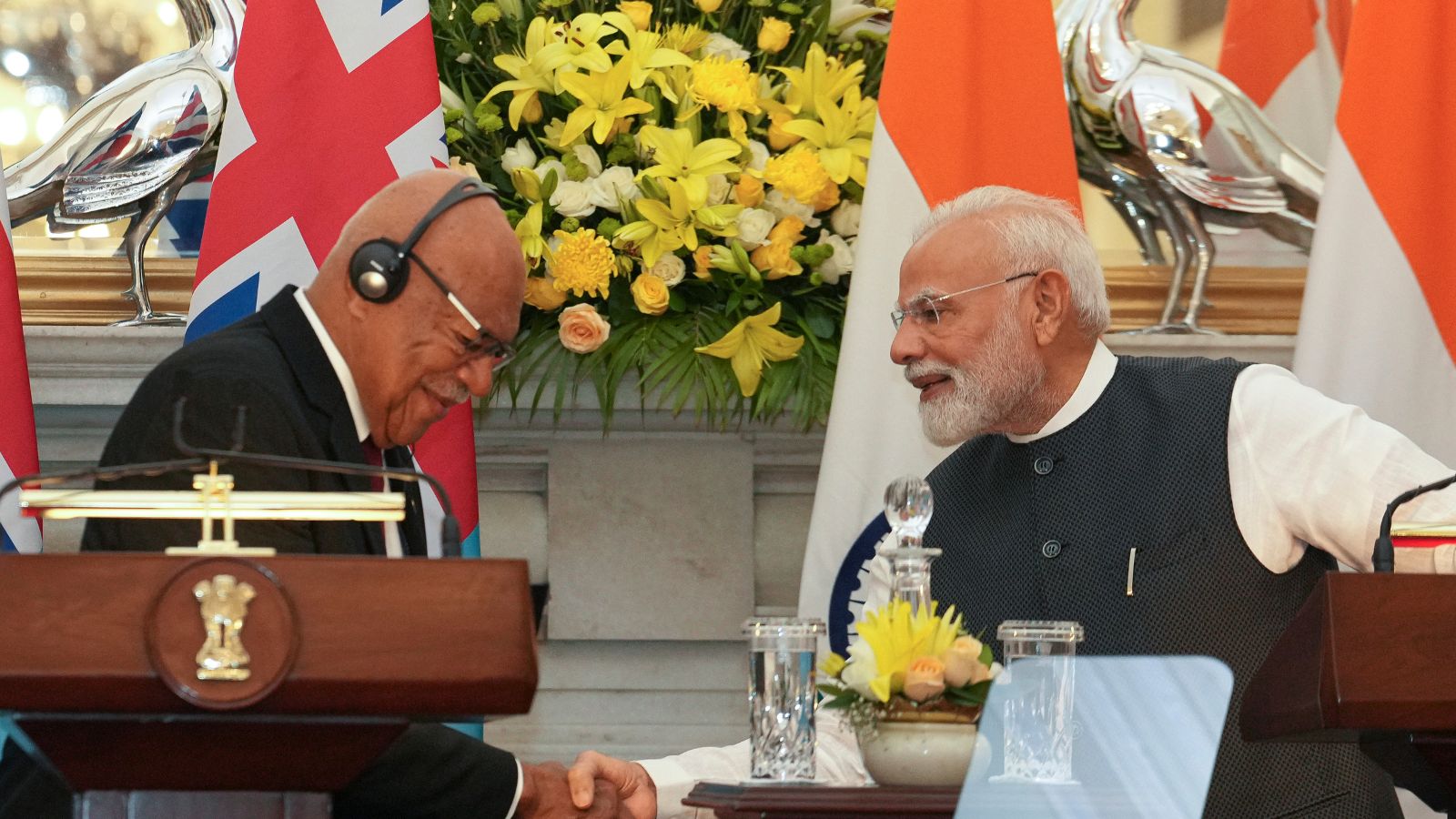
India and Fiji have announced a series of landmark initiatives to strengthen bilateral ties, following Prime Minister Rabuka’s visit to India. The leaders reaffirmed their shared commitment to development, cultural preservation, and regional cooperation, marking a new chapter in the India-Fiji partnership.
India will support the construction of a 100-bed super specialty hospital in Suva, along with the deployment of dialysis units and sea ambulances. Jan Aushadhi Kendras will be established to provide affordable, high-quality medicines, and a Jaipur Foot camp will be organised to ensure inclusive access to mobility aids.
In agriculture, India will gift 12 agri-drones and 2 mobile soil testing labs, building on the successful cultivation of cowpea seeds in Fijian soil. The Fijian government’s approval of Indian ghee was welcomed as a gesture of mutual trust and trade facilitation.
Defence and security cooperation will be expanded through a new action plan, including training and equipment support for maritime security, and collaboration in cyber security and data protection. Both nations reiterated their unified stance against terrorism and acknowledged Fiji’s support in India’s counter-terrorism efforts.
Cultural and educational exchanges will be deepened with Indian teachers set to teach Hindi and Sanskrit at the University of Fiji, and Fijian pandits invited to India for learning and participation in the Gita Mahotsav. The announcement of Girmit Day was praised as a tribute to the shared history of over sixty thousand indentured Indians who contributed to Fiji’s prosperity and cultural diversity.
India and Fiji will also collaborate on climate resilience and renewable energy, particularly solar power, through platforms such as the International Solar Alliance, the Coalition for Disaster Resilient Infrastructure, and the Global Biofuels Alliance. India will assist in strengthening Fiji’s disaster response capabilities.
Prime Minister Modi described Fiji as a hub in India’s Pacific Island cooperation strategy and endorsed Prime Minister Rabuka’s “Oceans of Peace” vision. Both leaders affirmed their commitment to a free, open, inclusive, and secure Indo-Pacific, and to shaping a world order that respects the independence, ideas, and identity of the Global South.