
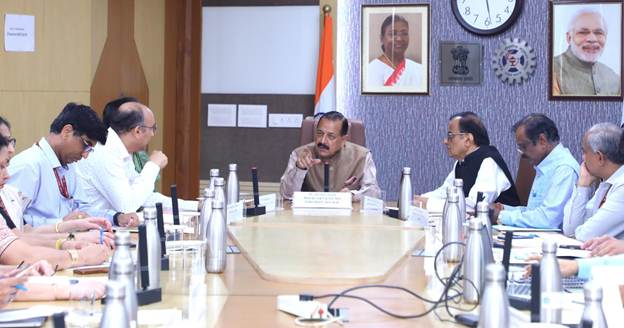
India has taken a significant step toward sustainable aviation with the development of Electric Hansa (E-Hansa), a next-generation two-seater electric trainer aircraft. Union Minister for Science & Technology Dr. Jitendra Singh announced the initiative during a high-level review meeting with science department secretaries, highlighting the country’s commitment to reducing aviation costs and promoting clean energy technology.
The E-Hansa, designed by the Council of Scientific & Industrial Research – National Aerospace Laboratories (CSIR-NAL) Bengaluru, is part of the larger HANSA-3 (NG) trainer aircraft program aimed at providing an indigenous, cost-effective alternative to imported flight trainers. With an estimated cost of $240,000, E-Hansa is projected to be nearly 50% cheaper than comparable foreign aircraft while aligning with India’s green aviation goals.
Beyond aviation, the meeting also focused on commercializing indigenous technologies through public-private partnerships (PPP). Dr. Singh directed the National Research Development Corporation (NRDC) to adopt successful tech transfer models from DBT-BIRAC and IN-SPACe, ensuring wider sectoral outreach and private sector engagement.
The Minister praised ISRO’s achievements, particularly the SPADEX mission, which successfully demonstrated docking and undocking capabilities crucial for India’s Gaganyaan human spaceflight program. He also lauded ISRO’s role in Operation Sindoor, reinforcing India’s aerospace leadership.
India’s global footprint in science and technology was further highlighted with discussions on bilateral collaborations, including potential partnerships with Switzerland and Italy modeled after existing Indo-French and Indo-German science centers.
Dr. Singh emphasized a “Whole-of-Science, Whole-of-Government” approach, advocating for regional Chintan Shivirs to foster synergy across scientific domains. Plans are underway for nationwide workshops uniting research institutions, government agencies, and industry stakeholders.
As part of India’s push toward biomanufacturing, the Minister proposed the Global Science Talent Bridge, an initiative designed to attract top researchers from around the world. He also reaffirmed India’s commitment to strengthening STEM education, recalling the enthusiastic response to the Prime Minister’s directive to open all 37 CSIR labs to students—a move temporarily paused due to security concerns but set to resume soon.
The meeting was attended by key officials, including Prof. Ajay Kumar Sood (Principal Scientific Advisor to the Government of India), Dr. N. Kalaiselvi (DG, CSIR), Dr. V. Narayanan (Chairman, ISRO), Dr. Abhay Karandikar (Secretary, DST), Dr. Rajesh Gokhale (Secretary, DBT), Dr. M. Ravichandran (Secretary, Earth Sciences), Dr. M. Mohapatra (DG, IMD), and Commodore Amit Rastogi (CMD, NRDC).
India’s advancements in electric aviation, space science, and technology commercialization reinforce its commitment to innovation-driven development, marking a pivotal step toward achieving self-reliance and sustainability in the aerospace sector.