

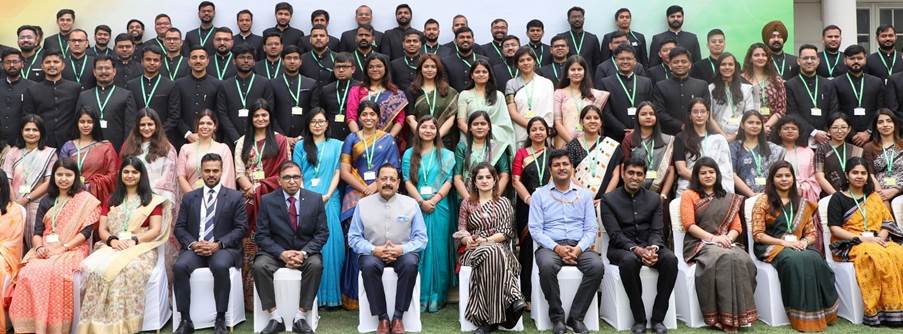
In a landmark achievement for gender representation in Indian governance, the 2023 IAS batch has recorded the largest-ever induction of women officers, with 74 women comprising 41 percent of the batch’s total strength of 180 officers. This achievement underscores India’s commitment to gender inclusivity and equality in public administration, as highlighted by Union Minister Dr. Jitendra Singh during his interaction with the Officer Trainees at the Assistant Secretary Programme in New Delhi.
The Assistant Secretary Programme, inaugurated in 2015 as part of Prime Minister Narendra Modi’s vision for nurturing capable civil servants, attaches Officer Trainees to 46 Central Ministries for an eight-week tenure to provide them with early exposure to governance and policymaking. Dr. Jitendra Singh praised this initiative, noting its significant impact on creating competent and confident officers equipped to address complex challenges, particularly during crisis situations like the pandemic.
Dr. Singh attributed the rise in women’s representation to Prime Minister Modi’s visionary leadership and the prioritization of women-led initiatives within government frameworks. He highlighted the democratisation of civil services, noting increased selections from regions such as Punjab, Haryana, and the North-East, which historically had lower representation.
The batch stands out for its diversity in academic and professional backgrounds, with 99 officers coming from engineering fields, alongside others from medicine and technical domains. Dr. Singh emphasized the importance of technocrats in governance, given the technical nature of flagship government programmes like Digital India and Smart Cities.
The youngest and most diverse batch, aged between 22 and 26 years, is expected to contribute significantly over the span of their careers toward India’s vision of “Viksit Bharat @2047.” Dr. Singh urged the officers to leverage technological advancements, such as the iGOT Karmayogi platform, to enhance their skills continuously.
Highlighting innovative governance practices, Dr. Singh underscored the role of technology as a leveller, referencing initiatives like the Swamitva Mission, which employs drone technology for property mapping, decentralizing service delivery and democratizing land record access. He also stressed the importance of grievance redressal mechanisms like the CPGRAMS platform, which has achieved a 98 percent resolution rate for over 26 lakh grievances.
The Minister advocated for a more dynamic civil service ecosystem, proposing exposure opportunities outside government for officers to return as domain specialists. He also emphasized human intelligence and empathy, alongside technological solutions, for effective governance.
Dr. Singh’s interaction with the Officer Trainees reflected his aspirations for India’s civil servants to embody the highest standards of integrity and service, aligning their efforts with the principles of Antyodaya to uplift the most marginalized sections of society. The batch’s diverse makeup and youthful vigor represent New India’s aspirations and potential to drive transformative changes in governance.