

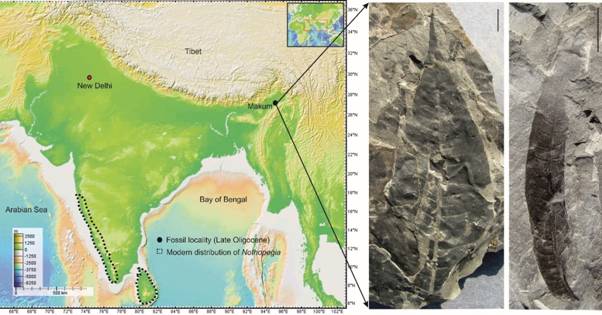
In a remarkable breakthrough, Indian scientists have discovered 24-million-year-old fossilized leaves in the Makum Coalfield of Assam, unveiling the world’s oldest known record of the plant genus Nothopegia, now exclusively found in the Western Ghats. The discovery, led by a team from the Birbal Sahni Institute of Palaeosciences (BSIP), offers a unique glimpse into prehistoric climate shifts that reshaped South Asia’s ecological map.
The fossil leaves, buried deep in the region’s ancient coal beds, were identified through comparative herbarium analysis and cluster mapping, revealing a striking resemblance to Nothopegia—a species that currently thrives in the rain-soaked, biodiverse forests of the Western Ghats. Using advanced climate modeling techniques, including the Climate Leaf Analysis Multivariate Program (CLAMP), researchers reconstructed the late Oligocene climate of Northeast India as warm and humid, akin to present-day conditions in the Western Ghats.
This suggests that millions of years ago, the Makum region provided a thriving habitat for Nothopegia, until dramatic tectonic and climatic changes altered the landscape. The uplift of the Himalayas radically cooled Northeast India, causing the local extinction of the tropical species while allowing its survival in the more climatically stable Western Ghats. Scientists described this phenomenon as a migration-driven survival route—a living example of how climate shifts influence biodiversity over geological time.
The study, published in Review of Palaeobotany and Palynology, highlights the importance of paleobotanical research in predicting how modern plant species might respond to accelerating climate change. Co-author Harshita Bhatia called the discovery “a window into the past that helps us understand the future,” emphasizing the critical need to protect biodiversity hotspots like the Western Ghats where ancient lineages endure.
The find also underscores India’s rising contributions to global paleoscience and renews focus on preserving ecosystems that serve as climate refuges for Earth’s biological heritage.