

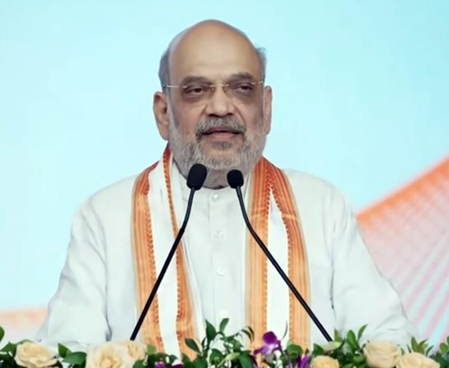
Union Home Minister and Minister of Cooperation Amit Shah performed the Bhoomi Poojan ceremony of India’s first cooperative university, ‘Tribhuvan’ Sahkari Vishwavidyalaya, in Anand, Gujarat. The event was attended by Gujarat Chief Minister Bhupendrabhai Patel, Union Ministers of State for Cooperation Krishan Pal Gurjar and Muralidhar Mohol, and Secretary, Ministry of Cooperation, Ashish Kumar Bhutani, among other dignitaries.
Describing the day as historic for the cooperative movement, Amit Shah stated that the university is a tribute to Tribhuvan Das Patel, whose vision and contribution to dairy cooperatives transformed the lives of millions of Indian farmers. Prime Minister Narendra Modi’s establishment of the Ministry of Cooperation four years ago was intended to empower the country’s rural poor and transform the cooperative movement. Since its formation, the ministry has launched 60 new initiatives to make cooperatives more democratic, transparent, and inclusive, particularly for farmers, women, Dalits, and tribal communities.
The new cooperative university, to be constructed on 125 acres of land at a cost of Rs 5 billion, aims to close critical gaps in education, training, and innovation within the cooperative sector. It will serve the 30 crore Indians affiliated with cooperatives—including 40 lakh workers and 80 lakh board members—by creating a structured education system that will produce trained professionals, not just post-recruitment but before employment. Shah declared that only those trained at this university will be eligible to work in cooperative societies, ending nepotism and fostering professionalism, accountability, and inclusivity.
Students will learn technical expertise, accounting, marketing, and scientific methods, while also embracing the moral ethos of cooperation. The university will contribute to research, strategy formulation, data analysis, and policymaking for cooperatives over five, ten, and twenty-five-year timeframes. It will also prepare cooperative leaders modeled after visionaries like Tribhuvan Das Patel, who under Sardar Patel’s guidance, created the Kheda District Cooperative Milk Producers Union in 1946—a movement that evolved into the world-renowned Amul cooperative brand. Shah noted that 3.6 million rural women now manage Amul’s Rs 800 billion turnover despite individual investments of less than Rs 100.
The government has committed to forming 200,000 new Primary Agricultural Credit Societies (PACS), of which 60,000 will be established this year alone. Together with 85,000 existing PACS, these societies will require qualified human resources, which ‘Tribhuvan’ Sahkari Vishwavidyalaya will provide. The university will also develop a standardised curriculum for cooperative training across the country and enable the implementation of sectoral policies and schemes.
The university is named after Tribhuvan Das Kishi Das Patel to honour his legacy in founding the dairy cooperative revolution. It will support the cooperative movement in designing innovative policies, transforming it into a mass movement, and fostering economic and social transformation through grassroots empowerment.
Shah also highlighted that the Central Board of Secondary Education has introduced cooperatives as a subject in classes 9 to 12, and recommended that the Gujarat government follow suit. Calling on cooperative trainers and experts from across India to contribute to the university, Shah concluded that the institution will mark a turning point, turning India’s cooperative system into a globally admired model.