



India at a Crossroads: Growth Momentum Faces Global Shockwaves
Mumbai: India finds itself navigating a complex economic landscape where resilience meets rising global uncertainty. While the country continues to be one of the fastest-growing major economies, new challenges—from geopolitical tensions to currency pressures—are beginning to test its momentum.
A recent United Nations outlook projects India’s economy to grow at 6.4% in 2026, reaffirming its position as a global growth engine despite headwinds. However, this optimism is increasingly being tempered by developments far beyond India’s borders.
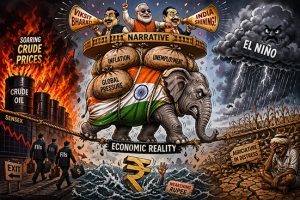
India growing at a fast pace and the momentum to continue.
The ongoing conflict in West Asia has triggered a sharp surge in global crude oil prices—up over 30% since late February—putting immense pressure on oil-importing nations like India. As the world’s third-largest crude importer, the country is particularly vulnerable, with rising fuel costs already translating into higher diesel prices across major cities.
The ripple effects are visible in financial markets as well. The Indian rupee has weakened amid global uncertainty, reflecting investor caution and increased demand for the U.S. dollar. Foreign investors have reportedly pulled significant funds from Indian equities in recent weeks, signaling a shift in risk appetite as geopolitical tensions escalate.
Adding to the narrative is India’s recent slip to the sixth-largest economy globally, a development that has sparked debate among economists. While the drop is largely attributed to currency depreciation rather than structural weakness, it underscores the fragile interplay between domestic strength and global forces.
Yet, the story is far from bleak.
India’s domestic demand, infrastructure push, and policy momentum continue to provide a strong foundation. Experts maintain that the country’s long-term trajectory remains intact, with projections suggesting it could still emerge as the third-largest economy in the coming decade.
But risks loom on multiple fronts.
Weather forecasts indicate a possible El Niño-driven weak monsoon, which could disrupt agriculture, fuel food inflation, and further strain the economy. At the same time, prolonged global instability could limit the government’s fiscal flexibility and complicate monetary policy decisions.
In essence, India’s growth story in 2026 is no longer just about domestic performance—it is deeply intertwined with global geopolitics, energy markets, and climate patterns.
As policymakers walk this tightrope, the coming months will determine whether India can convert resilience into sustained dominance—or whether external shocks will reshape its economic trajectory.
