
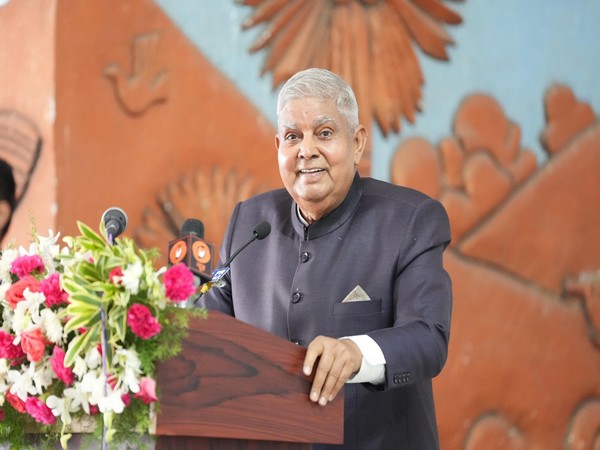
Vice President Jagdeep Dhankhar addressed students and faculty at the National University of Advanced Legal Studies (NUALS) in Kochi, delivering a comprehensive discourse on constitutional fidelity, institutional accountability and the transformative role of India’s youth in nation-building. Drawing a constitutional distinction, he pointed out that while the President and Governors take an oath to preserve, protect and defend the Constitution, the Vice President, Prime Minister, Chief Ministers, Members of Parliament and judiciary take an oath only to abide by it. He highlighted the unique constitutional immunity held exclusively by the President and Governors from prosecution while in office.
Dhankhar praised the Governor of Kerala, Rajendra V Arlekar, for maintaining high standards amid the inherent pressures of the gubernatorial role. He called the students “future sentinels of justice” and “torchbearers of constitutional values,” urging them to envision an equitable Bharat by the time India celebrates its centenary of independence in 2047.
He described Kerala as a land of upright public servants and intellectual excellence, commending the state’s nine Rajya Sabha members for their serious parliamentary conduct. He contrasted this with the deliberative legacy of the Constituent Assembly, urging students to learn from its culture of debate without disruption.
Encouraging active engagement with constitutional history, he invited students to submit essays on the significance of Constitution Day and the proclamation of Emergency on June 25, 1975, termed as “Samvidhan Hatya Diwas.” Five winners from each category will be hosted as guests in the Indian Parliament, with selections done through a lottery in the presence of Kerala’s Rajya Sabha members. Additional student batches will be invited to the new Parliament building, which Dhankhar said embodies 5,000 years of civilizational ethos and was constructed in under 30 months despite COVID-19 challenges.
He paid tribute to Kerala’s judicial legacy, highlighting Justice M. Fathima Beevi as India’s first female Supreme Court judge and Justice Bahrul Islam of Assam, both of whom were elevated from retirement. He traced the state’s historical evolution of jurisprudence from ancient texts and early foreign trade through colonial legal influences.
Underscoring India’s millennia-old civilizational continuity, he stated that Bharat was not born in 1947 but has been nurtured over 5,000 years with intellectual traditions rooted in the Vedas, Upanishads, and Nalanda-Takshashila institutions. He called India the most aspirational nation globally due to its youthful demographic, with a median age of 28.
Dhankhar cautioned that economic rise and global recognition bring new challenges, which must be met with courage, not rationalisation of failure. He warned against institutional discord, stating that the doctrine of separation of powers must be upheld. While asserting that each constitutional institution is supreme in its domain, he warned against judicial overreach into executive appointments and decisions, specifically questioning why the Chief Justice of India is involved in appointing an executive functionary such as the CBI Director.
He praised recent steps toward transparency and accountability in the judiciary under the current and immediate past Chief Justices, but termed the preceding two years as turbulent and abnormal, requiring course correction.
Expressing grave concern over a high-profile incident in which a large quantity of cash was found at a High Court judge’s residence during a fire on the night of March 14–15, he noted that the matter became public only a week later. He stressed the need to investigate this potential criminal act, register an FIR and ensure transparency, stating that the integrity of judiciary—held in high public trust—was shaken. He cited a Supreme Court judgment from the early 1990s that hampers FIR registration in such cases and called for a constitutional mechanism to address judicial accountability without undermining independence.
He raised concerns about post-retirement appointments of judges, warning that selective accommodation through government patronage compromises judicial integrity. He urged students to debate these issues weekly in small groups and reaffirmed his lifelong dedication to the judiciary.
Dhankhar concluded by highlighting the expansive opportunities for law graduates in emerging domains such as the blue economy, cybersecurity and space policy. He said the current ecosystem is full of hope and possibility, unlike in previous generations, and declared the contract complete with students’ acceptance of his offer to visit Parliament, coordinated with Kerala MPs and NUALS administration.