
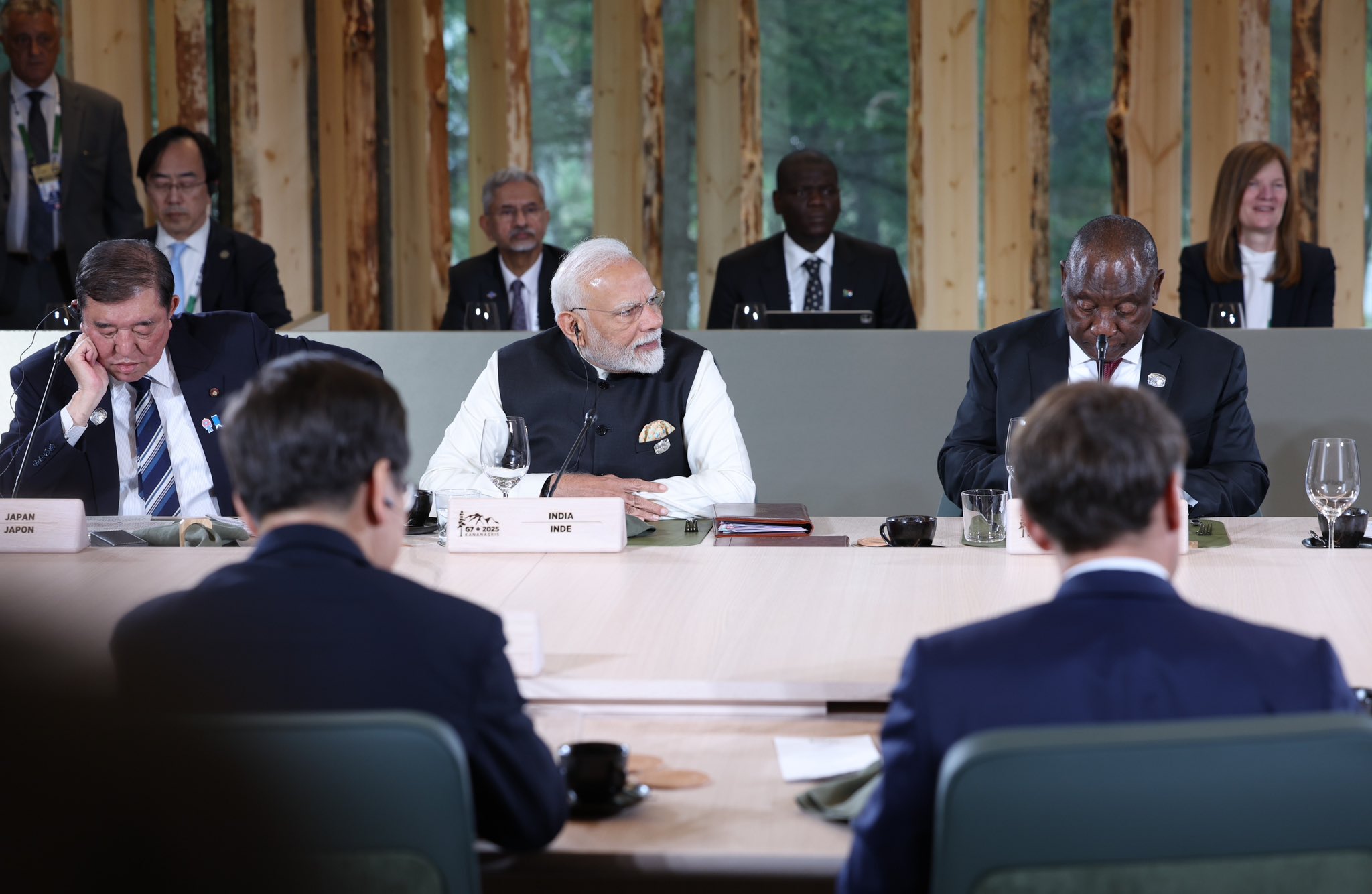
Prime Minister Narendra Modi delivered a sharp and unapologetic address at the G7 Outreach Session in Kananaskis, Canada, challenging the global order to abandon hypocrisy on terrorism, embrace equitable energy transitions, and ensure artificial intelligence serves humanity—not hegemony. Speaking on the 50th anniversary of the G7, Modi positioned India not as a participant seeking validation, but as a sovereign voice of the Global South demanding accountability and reform.
He opened by framing energy security as a defining challenge for future generations, asserting that India’s approach—anchored in availability, accessibility, affordability, and acceptability—offers a replicable model. Despite being the world’s fastest-growing major economy, India has met its Paris climate goals ahead of schedule and is driving global initiatives like the International Solar Alliance, Global Biofuels Alliance, and One Sun-One World-One Grid. Modi called on the international community to strengthen these platforms rather than sideline them.
Turning to the Global South, Modi condemned the cascading impact of global conflicts and economic disruptions on vulnerable nations. He declared that India had taken it upon itself to amplify their voices on the world stage, insisting that any serious conversation about a sustainable future must begin with the priorities of the Global South—not as an afterthought, but as a foundation.
Modi’s most forceful intervention came on terrorism. Referring to the April 22 attack in Pahalgam, he called it not just an assault on India but on all humanity. He demanded that the world stop rewarding nations that sponsor terror while punishing others for lesser offenses. “Will countries understand the grave threat posed by terrorism only when they become a target?” he asked. “How can perpetrators of terror and its victims be equated?” He warned that global institutions must not remain mute spectators and that double standards in dealing with terrorism are a betrayal of humanity.
On artificial intelligence, Modi acknowledged its transformative potential but cautioned that it is energy-intensive and must be made sustainable through clean energy. He emphasized India’s human-centric approach to technology, where innovation must serve the common citizen. He called for global governance frameworks to address AI-related risks and highlighted India’s rich, diverse data landscape as a critical asset for building responsible AI systems. He also stressed the need for secure and resilient supply chains for critical minerals in the AI era.
Modi concluded by urging nations to place people and planet at the center of progress and called for deeper cooperation to build a technology-led, sustainable future. His message was clear: India will not be lectured to, sidelined, or silenced. It will lead—on its own terms, with its own voice, and in solidarity with those long ignored by the old order. The G7, he implied, must now choose whether to evolve or be left behind.