

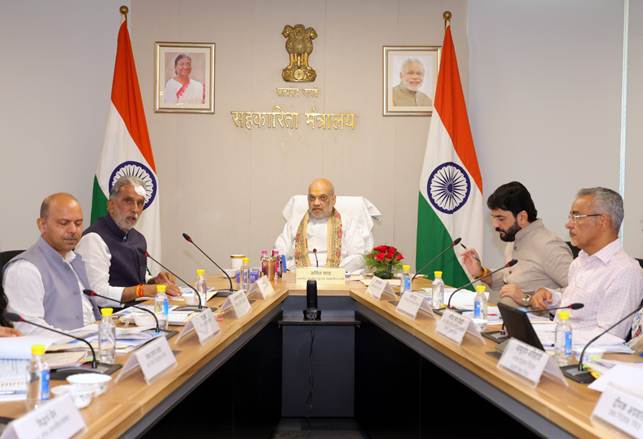
India’s ambitious cooperative food grain storage scheme took a decisive step forward as Union Home Minister and Minister of Cooperation Amit Shah chaired a high-level review meeting in New Delhi, reaffirming the government’s commitment to strengthening rural economies and bolstering food security. The initiative, the largest of its kind globally, aligns with Prime Minister Narendra Modi’s vision of self-reliance through cooperation, a model that enhances both economic growth and employment generation.
The scheme is designed to elevate the financial viability of Primary Agricultural Credit Societies, which play a crucial role in India’s agrarian economy by providing credit access to farmers. Shah emphasized the necessity of extending the loan facility under the Agriculture Infrastructure Fund to ensure long-term financial sustainability for these cooperatives, urging greater engagement from key institutional players, including the Food Corporation of India, the National Cooperative Consumers’ Federation, the National Agricultural Cooperative Marketing Federation, and State Warehousing Corporations. The minister directed agencies to intensify efforts to integrate Primary Agricultural Credit Societies into as many warehouse networks as possible, ensuring widespread participation in the initiative.
Recognizing the need for efficient implementation, Shah called for a national mapping of warehouses to streamline storage distribution across regions. He stressed the significance of coordinated action between state governments and cooperative marketing federations to establish a complete cooperative supply chain. The inclusion of additional Primary Agricultural Credit Societies at the state level would accelerate implementation while fostering decentralized access to resources.
Shah reaffirmed that timely execution of the food grain storage scheme would serve as a cornerstone of India’s self-reliance strategy, reinforcing the cooperative sector’s capacity to sustain agricultural growth and job creation. He urged stakeholders to ensure seamless coordination, describing the initiative as a milestone in achieving the broader goal of economic self-sufficiency. The government remains committed to leveraging cooperative networks to enhance storage capacity, stabilize food distribution, and enable rural communities to benefit from modern infrastructure advancements.