

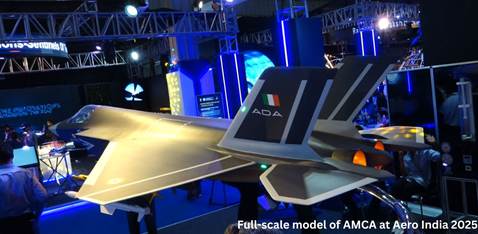
India has formally approved the development of its first fifth-generation stealth fighter jet, the Advanced Medium Combat Aircraft (AMCA), marking a significant leap in its aerospace and defense capabilities. The decision comes at a critical moment, as China accelerates its efforts to supply Pakistan with J-35A stealth fighters, raising concerns over regional air superiority.
The Ministry of Defence, under the leadership of Rajnath Singh, has approved the AMCA Programme Execution Model, ensuring equal participation from private and public sector companies in a competitive bidding process. The Aeronautical Development Agency (ADA) will oversee the program, inviting bids from Indian firms independently or through joint ventures and consortia. The AMCA project is expected to provide India with a technologically superior fighter aircraft capable of countering emerging threats in the region and beyond.
The AMCA is designed as a multi-role stealth fighter incorporating cutting-edge technologies such as low radar cross-section for enhanced survivability, supercruise capabilities to sustain supersonic speeds without afterburners, and advanced sensors and weapons, including AESA radar, electronic warfare systems, and next-generation missiles. The aircraft will be powered by the GE F414 engine in its initial phase, with plans for the development of an indigenous AL-51 engine for future variants, reinforcing India’s push for self-reliance in defense manufacturing under the Atmanirbhar Bharat initiative.
Meanwhile, China has fast-tracked the delivery of J-35A stealth fighters to Pakistan, aiming to bolster its air combat capabilities in response to India’s growing technological advancements. The J-35A, based on the FC-31 platform, features stealth optimization for carrier operations, advanced avionics for multi-role combat missions, and integration with Chinese air defense networks, including HQ-9 missile systems. Additionally, Pakistan has deployed over 200 engineers and technicians to work with Turkish Aerospace Industries on Turkey’s TF-X fifth-generation fighter project, demonstrating a multi-nation collaboration to modernize its air force.
India’s approval of the AMCA program serves as a direct response to China’s growing military footprint in South Asia. The aircraft will complement India’s existing fleet of Rafale, Su-30MKI, and Tejas fighters, ensuring dominance in regional airspace while strengthening the country’s defense posture against potential threats. The program’s execution model aims to drive innovation within India’s aerospace sector, allowing firms such as HAL, Tata, and L&T to contribute to the country’s next-generation fighter development.
With China ramping up J-20 production and Pakistan seeking stealth capabilities, India’s AMCA project is expected to solidify its position as a global defense leader, reinforcing its strategic dominance in the region and ensuring long-term security and technological supremacy. As the AMCA prototype prepares for unveiling by 2030, the program underscores India’s commitment to self-reliance and advanced warfare capabilities.