
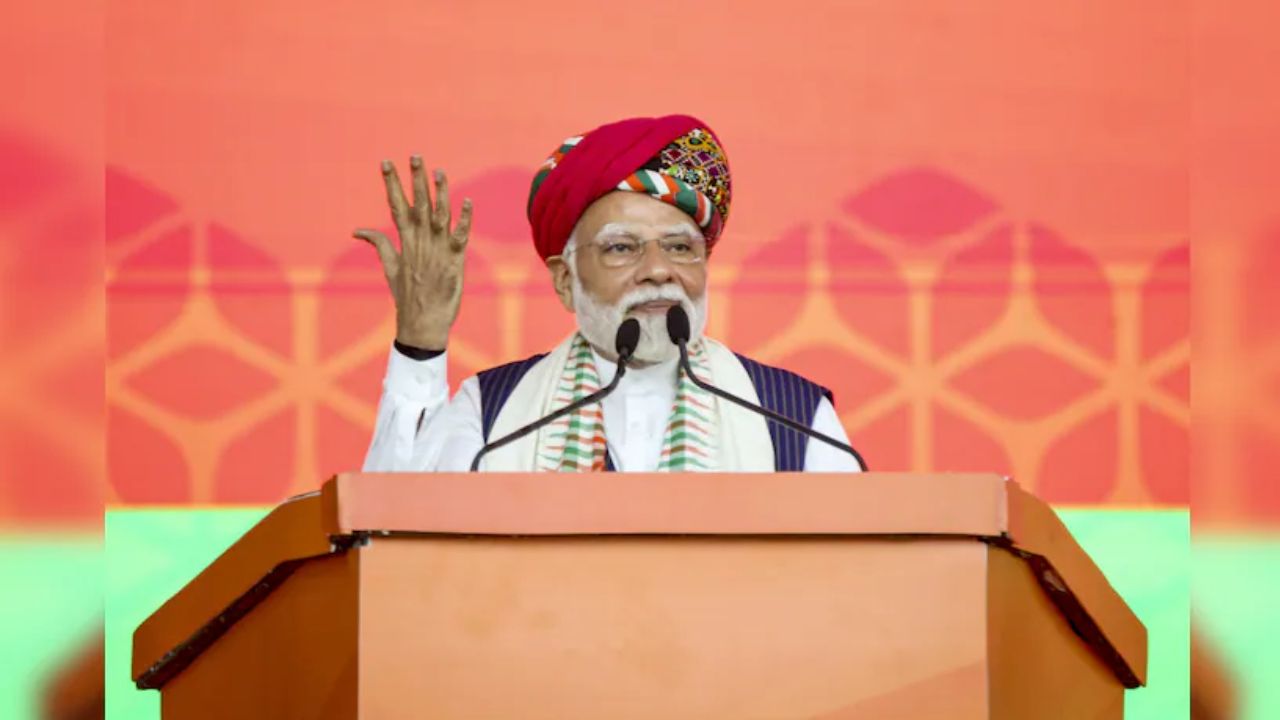
Prime Minister Narendra Modi addressed the 20-year celebrations of Gujarat’s Urban Growth Story, marking two decades of transformative urban development initiatives. Speaking at Gandhinagar, Gujarat, he launched the Urban Development Year 2025, reinforcing his vision for economic expansion through structured urban policies.
Reflecting on India’s military successes, Modi hailed the triumph of Operation Sindoor, stating that the operation’s impact extends beyond counter-terrorism, symbolizing a nationwide responsibility to eliminate economic dependency on foreign goods. He stressed that terrorism is no longer proxy warfare but a strategic military confrontation, demanding equally decisive responses. Modi cited the elimination of nine terror bases within 22 minutes, with real-time camera documentation ensuring full transparency. He asserted that funerals of militants in Pakistan, complete with national flag honors and military salutes, confirmed the state-sponsored nature of such aggressions.
Emphasizing India’s ethos of Vasudhaiva Kutumbakam, Modi stated that while India desires peace, it will retaliate strategically against threats. He recalled Pakistan’s repeated military defeats, acknowledging that the neighboring country had shifted to asymmetric warfare after failing in direct conflict. Modi reinforced that India remains committed to progress and global contributions, ensuring economic and military stability.
Highlighting his 11-year tenure as Prime Minister, Modi reflected on India’s rise from the world’s 11th-largest economy in 2014 to fourth place in 2025, despite challenges like COVID-19, geopolitical tensions, and natural disasters. He declared that India will be fully developed by 2047, urging citizens to rally behind economic independence through Made in India branding.
Modi linked economic growth with urban transformation, stating that cities must evolve beyond population expansion to function as economic hubs. He underscored that India’s two million startups—mostly in tier-2 and tier-3 cities—demonstrate decentralized innovation, with women entrepreneurs leading the way. He advocated municipal bodies setting economic targets, prioritizing value-added industries, agro-processing, and high-quality manufacturing.
Recalling Gujarat’s transformation, Modi reminisced about skepticism surrounding the state’s growth potential during its early years. He illustrated Gujarat’s evolution from a salt-producing state to a global diamond hub, citing structured planning and integrated governance as key enablers of success. He highlighted pioneering urban development campaigns, including the riverfront projects, tourism initiatives, and large-scale infrastructure projects like the Sabarmati Riverfront and GIFT City. Modi stated that the statue-building projects, including the Statue of Unity, reshaped national identity and economic prospects.
He reiterated that Operation Sindoor’s national significance extends to self-reliance, urging citizens to prioritize domestic products, replacing foreign imports with Indian alternatives. He linked economic resilience to national security, advocating the One District, One Product initiative to boost local industries. Modi called upon entrepreneurs, farmers, and industrialists to champion indigenous manufacturing, ensuring India’s continued rise as a global economic force.
The Prime Minister commended Gujarat’s leadership in urban planning, expressing confidence in India’s future as a global power. He reaffirmed the government’s dedication to economic independence, infrastructure expansion, and urban modernization, positioning India on track to become the world’s third-largest economy.
At the event, Modi inaugurated multiple urban infrastructure projects and allocated 3.3 billion rupees to urban local bodies under the Swarnim Jayanti Mukhyamantri Shaheri Vikas Yojana, reinforcing Gujarat’s commitment to sustainable development. The celebration signified India’s broader vision for growth, unity, and international leadership, cementing the nation’s resolve to achieve developed status by 2047.