

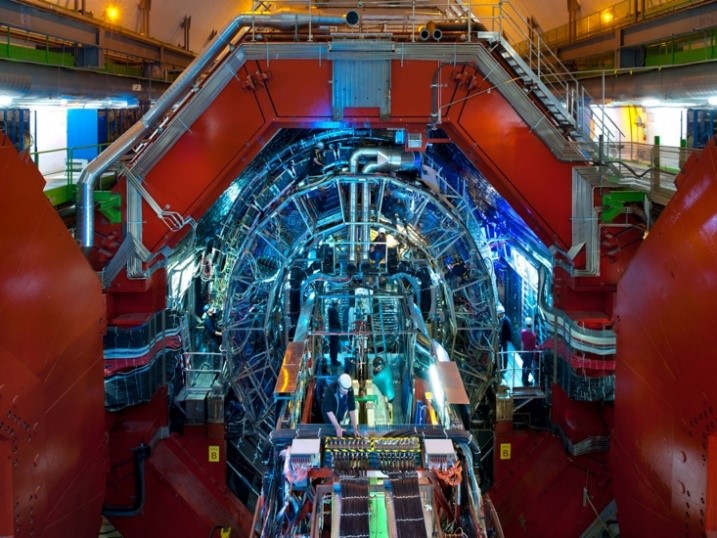
India’s long-standing participation in CERN’s Large Hadron Collider (LHC) experiments has received global recognition as the Breakthrough Prize in Fundamental Physics 2025 was awarded to researchers from the ATLAS, CMS, ALICE, and LHCb collaborations. The prestigious $3 million prize, based on publications from Run-2 data (2015–2024), will provide research grants to doctoral students from member institutes, enabling hands-on experience at CERN.
Indian researchers have played a pivotal role in the ALICE (A Large Ion Collider Experiment) and CMS (Compact Muon Solenoid) collaborations, contributing extensively to detector development, data acquisition, and high-energy particle physics analysis. Institutes such as TIFR Mumbai, IISc Bengaluru, Panjab University, IITs, and IISERs have actively participated in technical and theoretical advancements crucial to the LHC’s success.
India’s contributions to CERN date back to the 1960s, when TIFR scientists collaborated on early experiments involving pion, kaon, and proton beams. Over subsequent decades, Indian teams played vital roles in hardware development, software integration, neutron-proton ratio studies, and heavy-ion physics. The signing of the 1991 India-CERN cooperation agreement, followed by the 2009 Memorandum of Understanding, cemented India’s involvement in accelerator technology, detector R&D, and computing infrastructure. Recognizing India’s scientific leadership, CERN awarded the country Observer Status in 2002, leading to Associate Membership in 2017.
Indian scientists have designed and developed key LHC components, including cryogenics, superconducting magnets, collimators, vacuum chambers, and radio-frequency systems, enabling stable high-energy collisions for groundbreaking discoveries. The Photon Multiplicity Detector and Muon Spectrometer, engineered by Indian teams, have been instrumental in quark-gluon plasma studies within the ALICE experiment. Researchers from the CMS collaboration contributed to the trigger systems, Resistive Plate Chambers (RPCs), and Hadron Outer Calorimeter, significantly advancing Higgs boson searches and beyond Standard Model (BSM) investigations.
India is also a major partner in the Worldwide LHC Computing Grid (WLCG), hosting Tier-2 centers at TIFR Mumbai and VECC Kolkata, which have processed over 17.5 million ALICE jobs in 15 years. Indian scientists developed GRIDVIEW (monitoring) and SHIVA (problem tracking) software, dedicating over 1,000 person-months to essential computational infrastructure.
Looking ahead, Indian teams are deeply involved in CMS Phase-2 upgrades, contributing to the Outer Tracker (OT), Gas Electron Multiplier (GEM), High Granular Calorimeter (HGCAL), and Trigger System for high-luminosity LHC conditions. Additionally, India is leading the development of the Forward Calorimeter (FoCal) detector in ALICE, enabling precise photon and pion measurements for proton structure studies.
The Breakthrough Prize in Fundamental Physics celebrates decades of international collaboration and India’s role as a key contributor to particle physics advancements. As LHC experiments enter a new phase of discovery, India stands at the forefront of high-energy physics, scientific computing, and theoretical explorations that will continue to shape our understanding of the universe’s fundamental forces.