

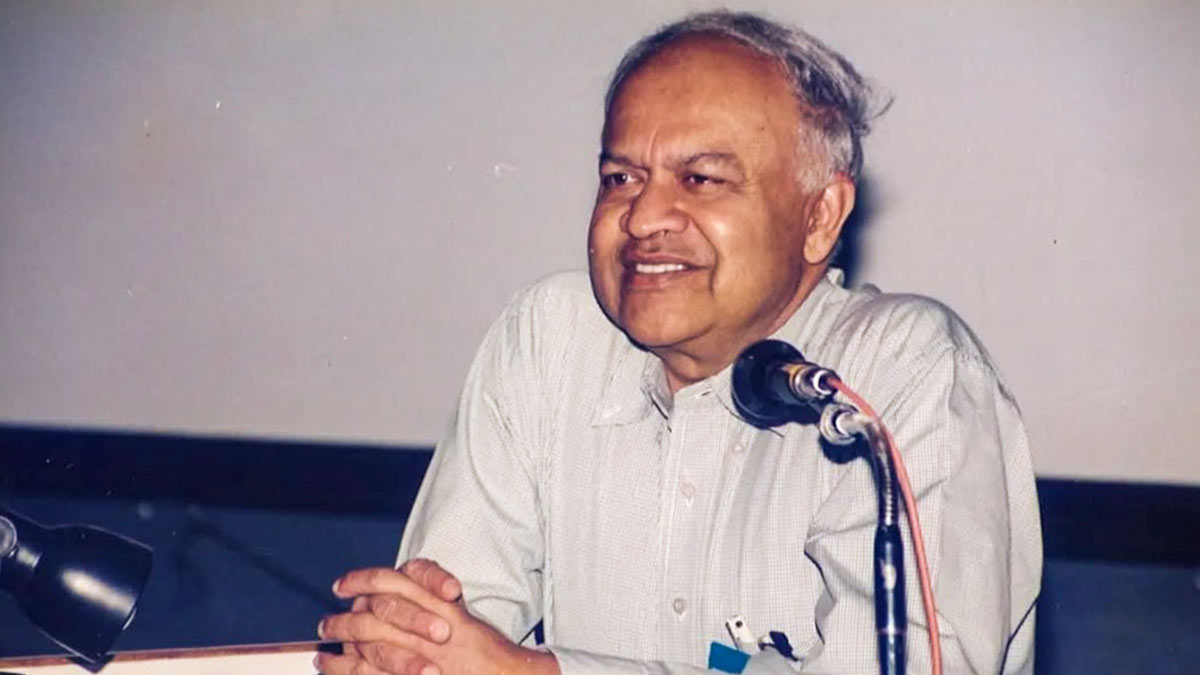
By Gopala Subramanian
Pune, May 20, 2025 — India today bids farewell to one of its most iconic scientific minds, Professor Jayant Vishnu Narlikar, who passed away peacefully at the age of 87. An astrophysicist of global repute, institution builder, and beloved science communicator, Narlikar leaves behind a legacy that shaped both the outer reaches of cosmological research and the public imagination within India.
A Legacy Rooted in Excellence
Born in Kolhapur in 1938 into an intellectually vibrant family—his father was a noted mathematician—Jayant Narlikar quickly rose to prominence in the scientific world. He studied at Banaras Hindu University before moving to Cambridge University, where he collaborated with the renowned British astronomer Sir Fred Hoyle. Their joint work led to the formulation of the Hoyle–Narlikar theory of gravity, a significant alternative model to Einstein’s general relativity and the Big Bang theory.
Unlike most contemporaries, Narlikar was unafraid to challenge prevailing cosmological narratives. The Hoyle–Narlikar theory proposed a steady-state universe and sought to explain phenomena like cosmic expansion through novel mechanisms. While the Big Bang theory gained dominance, Narlikar’s models contributed to deeper scrutiny of foundational assumptions in physics and astronomy.
Visionary Institution Builder
Perhaps his most lasting institutional legacy is the founding of the Inter-University Centre for Astronomy and Astrophysics (IUCAA) in Pune in 1988. Designed as a collaborative space where scholars from different universities could pursue advanced research in astrophysics, IUCAA has become a cornerstone of Indian space science and a training ground for some of the country’s most accomplished astronomers.
As the founding director, Narlikar envisioned IUCAA not as an ivory tower but as a crucible of open inquiry. The institution emphasized not only theoretical research but also outreach, inclusivity, and accessibility.
Popularizer of Science
In a country where science education often struggles with rote learning and abstract theory, Jayant Narlikar played the vital role of interpreter. He wrote extensively in both English and Marathi to bring cosmology and physics closer to the common person. Through books, television lectures, school outreach programs, and newspaper columns, he made relativity, black holes, and quantum mechanics less intimidating and more exciting for young minds.
His science fiction stories and popular science essays bridged the gap between scientific thought and creative imagination, leaving a unique imprint on Indian science culture.
Honors and Influence
Over his career, Narlikar received India’s highest civilian honors, including the Padma Bhushan and the Padma Vibhushan. Internationally, his work was recognized through fellowships and accolades that placed him among the world’s most respected physicists. He also served as President of the Cosmology Commission of the International Astronomical Union.
Despite his international standing, Narlikar chose to live and work in India, investing his intellect and energy in building scientific capacity within the country. He remained a vocal advocate for rational thinking, secularism, and the importance of a scientific outlook in national life.
Personal Life and Enduring Values
Professor Narlikar was married to mathematician Mangala Narlikar, who passed away in 2023. Together, they raised three daughters—Geeta, Girija, and Leelavati—who have followed paths in science and research, continuing the family’s dedication to knowledge.
He remained active in writing and public engagement well into his later years, often addressing concerns about the decline in scientific temper and the rise of pseudoscience.
Farewell to a Star-Gazer
Jayant Narlikar’s passing marks the end of an era in Indian science. He was not just a theoretician of the universe but a practical dreamer who believed in democratizing access to science. His contributions live on in every student he inspired, every observatory he helped shape, and every mind he opened to the cosmos.
India has lost a quiet giant, but the light he kindled will continue to illuminate pathways for generations to come.