



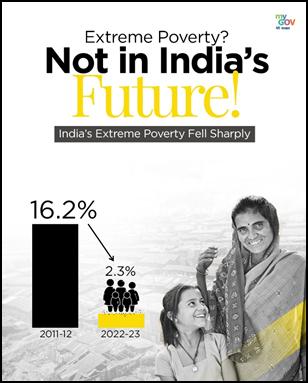
India has achieved one of the most remarkable milestones in its fight against poverty, lifting **171 million** people out of extreme poverty over the past decade. The World Bank’s Spring 2025 Poverty and Equity Brief acknowledges this sharp decline, noting that the proportion of Indians living on less than **2.15 US dollars** per day fell from **16.2% in 2011-12** to **2.3% in 2022-23**.
The government’s commitment to inclusive development has played a crucial role in this transformation. Targeted welfare programs, economic reforms, and expanded access to essential services have contributed to narrowing the poverty gap across both rural and urban India. Rural extreme poverty dropped from **18.4% in 2011-12** to **2.8% in 2022-23**, while urban extreme poverty declined from **10.7% to 1.1%** over the same period. The gap between urban and rural poverty reduced from **7.7 percentage points to 1.7 percentage points**, demonstrating a consistent annual decline rate of **16%**.
India has also made significant strides in reducing poverty at the lower-middle-income level, measured at **3.65 US dollars** per day. The poverty rate at this benchmark fell from **61.8% in 2011-12** to **28.1% in 2022-23**, lifting **378 million** people out of poverty. Rural poverty at this level dropped from **69% to 32.5%**, while urban poverty decreased from **43.5% to 17.2%**.
The five most populous states—Uttar Pradesh, Maharashtra, Bihar, West Bengal, and Madhya Pradesh—accounted for **65%** of India’s extreme poor in **2011-12**. By **2022-23**, these states contributed to two-thirds of the overall decline in extreme poverty, highlighting their crucial role in the nation’s poverty reduction efforts.
India has also witnessed a significant decline in **non-monetary poverty**, as measured by the Multidimensional Poverty Index, which considers education, health, and living conditions. The index showed a drop from **53.8% in 2005-06** to **16.4% in 2019-21**, with the World Bank’s updated estimate placing it at **15.5% in 2022-23**. India’s **consumption-based Gini index improved from 28.8 in 2011-12 to 25.5 in 2022-23**, signaling a reduction in income inequality.
Employment trends in India have further reinforced economic growth and poverty reduction. Since **2021-22**, employment growth has outpaced the expansion of the working-age population, especially among women. Urban unemployment fell to **6.6% in Q1 FY24/25**, the lowest since **2017-18**. There has also been a shift of male workers from rural to urban areas, while rural female employment in agriculture continues to rise. Self-employment has increased, particularly among rural workers and women, strengthening economic participation.
India’s rapid progress in poverty alleviation sets a strong foundation for sustained development and economic inclusion. The World Bank’s findings affirm the country’s commitment to reducing inequality, expanding opportunities, and maintaining a steady trajectory toward eliminating extreme poverty in the coming years.
