

India is set to achieve a monumental milestone in its space exploration journey as an Indian astronaut prepares to travel to the International Space Station (ISS) next month. This historic mission will mark the first visit by an Indian to the ISS and the country’s first human spaceflight in over four decades since Rakesh Sharma’s iconic 1984 mission aboard a Soviet Soyuz spacecraft.
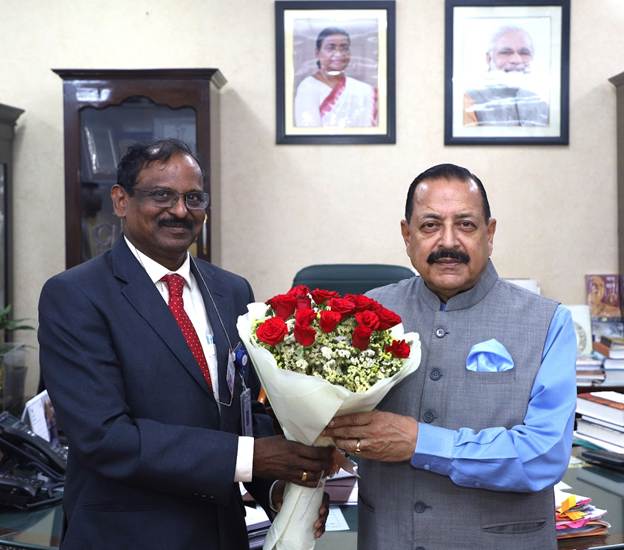
The announcement was made by the Union Minister of State for Science and Technology, Earth Sciences, and Space, Dr. Jitendra Singh, following a high-level meeting to review the Indian Space Research Organisation’s (ISRO) plans for the coming months. The minister hailed this mission as a pivotal moment in India’s space program and a testament to the nation’s commitment to advancing its capabilities in human space exploration.
Leading the mission to the ISS is Group Captain Shubhanshu Shukla of the Indian Air Force, a decorated test pilot and a key figure in ISRO’s Human Spaceflight Program. Scheduled to fly as part of Axiom Space’s Ax-4 mission in May 2025, Group Captain Shukla’s journey is expected to play a crucial role in refining India’s crewed spaceflight protocols. His participation will provide valuable experience in spaceflight operations, microgravity adaptation, and emergency preparedness, paving the way for India’s ambitious Gaganyaan mission.
This mission goes beyond symbolic significance, signaling India’s growing integration into global space partnerships. It underscores the nation’s strategic focus on operational readiness and its emergence as a serious contender in the global human space exploration arena. Dr. Jitendra Singh emphasized that such international collaborations reflect India’s vision of becoming a global leader in space technology while contributing to its broader goals of self-reliance and innovation.
The meeting also reviewed several key achievements and upcoming missions under ISRO’s banner. Among the highlights was the recent demonstration of docking and undocking technologies and the successful test of India’s highest-thrust liquid engine. These advancements are poised to bolster India’s capabilities in reusable launch vehicle development and complex crewed space operations. ISRO further outlined plans for a series of critical missions, including the launch of the EOS-09 Earth observation satellite, the NISAR joint NASA-ISRO satellite, and a commercial satellite launch for AST SpaceMobile.
From May through July 2025, ISRO is set to undertake an intensive schedule of launches that will shape the future of India’s space program. The PSLV-C61 mission, carrying the EOS-09 satellite equipped with cutting-edge radar imaging technology, will deliver unprecedented data for environmental monitoring and disaster management. The Test Vehicle-D2 mission, designed to validate the Gaganyaan Crew Escape System, will include sea recovery operations for its Crew Module, simulating conditions for India’s first indigenous crewed spaceflight. In June, the NISAR satellite, a collaborative project with NASA, will launch aboard a GSLV, combining India’s and the United States’ technological expertise to study Earth’s ecosystems and natural hazards. July will witness the deployment of BlueBird Block-2 satellites under a commercial contract, further reinforcing India’s growing footprint in global commercial satellite services.
The advancements in India’s space program have not been limited to technology. ISRO’s community initiatives, including satellite-based monitoring during the Kumbh Mela 2025, reflect the organization’s dedication to leveraging space technology for societal benefits. The resumption of missions to restart the Vikas Engine also demonstrates India’s focus on technological sustainability and innovation.
Group Captain Shubhanshu Shukla’s upcoming mission encapsulates the spirit of a confident and ambitious India, poised to take its rightful place among the leading nations in space exploration. His journey represents not just a milestone in India’s space program but a bold statement of the country’s aspirations to push the boundaries of human knowledge and technological achievement. As India steps boldly into the future, this mission to the ISS is set to inspire generations and solidify its standing as a formidable force in the global space community.