
Forever News
Women’s Reservation Bill: A Transformative Step or Political Symbolism?
The Women’s Reservation Bill, formally known as the Nari Shakti Vandan Adhiniyam, seeks to reserve 33% of seats in the Lok Sabha and state legislative assemblies for women—a long-pending reform aimed at correcting India’s gender imbalance in politics. Today, women constitute barely around 15% of Members of Parliament, highlighting the structural barriers that have limited their participation in governance.
At its core, the Bill promises to reshape Indian democracy by making it more inclusive and representative. But how exactly will it help?
Bridging the Representation Gap
The most immediate impact of the Bill is numerical—more women in legislative bodies. Increased representation is not just symbolic; it changes the nature of political discourse. Experiences from grassroots governance show that women leaders often prioritize issues like healthcare, education, water supply, and social welfare—areas that directly affect everyday life.
By ensuring a critical mass of women lawmakers, the Bill can normalize female leadership and inspire greater political participation at all levels.
Strengthening Policy Outcomes
Women’s presence in decision-making bodies brings diverse perspectives that can lead to more balanced policymaking. Gender-sensitive laws on safety, workplace equality, maternal health, and child welfare are more likely to gain traction when women are part of the legislative process.
In this sense, the Bill is not just about representation—it is about improving governance quality. A more inclusive Parliament is better equipped to address the needs of a diverse population.
Political Empowerment and Social Change
The Bill has the potential to trigger a broader social transformation. Political empowerment often translates into social empowerment. When women occupy positions of authority, it challenges entrenched patriarchal norms and redefines societal expectations.
This ripple effect can encourage higher female participation in education, employment, and entrepreneurship, thereby contributing to overall economic growth.
Boost to Democratic Legitimacy
A democracy is strongest when it reflects the composition of its society. With women making up nearly half of India’s population, their underrepresentation weakens democratic legitimacy. The Bill helps correct this imbalance, making governance more representative and accountable.
The Challenges Ahead
Despite its promise, the Bill is not without concerns. Its implementation is linked to future delimitation and census exercises, which could delay its rollout. Critics also argue that reservation alone may not address deeper issues like political dynasties or tokenism, where women may end up as proxies for male relatives.
Debates around sub-quotas for backward classes within the women’s quota also remain unresolved.
The Bottom Line
The Women’s Reservation Bill is a historic opportunity to redefine India’s political landscape. While it may not be a complete solution to gender inequality, it is undeniably a powerful starting point. If implemented effectively, it can move India closer to a more inclusive, equitable, and representative democracy—where women are not just participants, but equal decision-makers shaping the nation’s future.
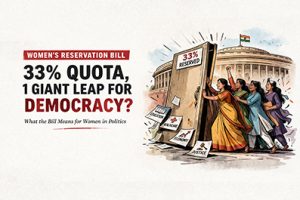
Women’s reservation bill explained visually.