

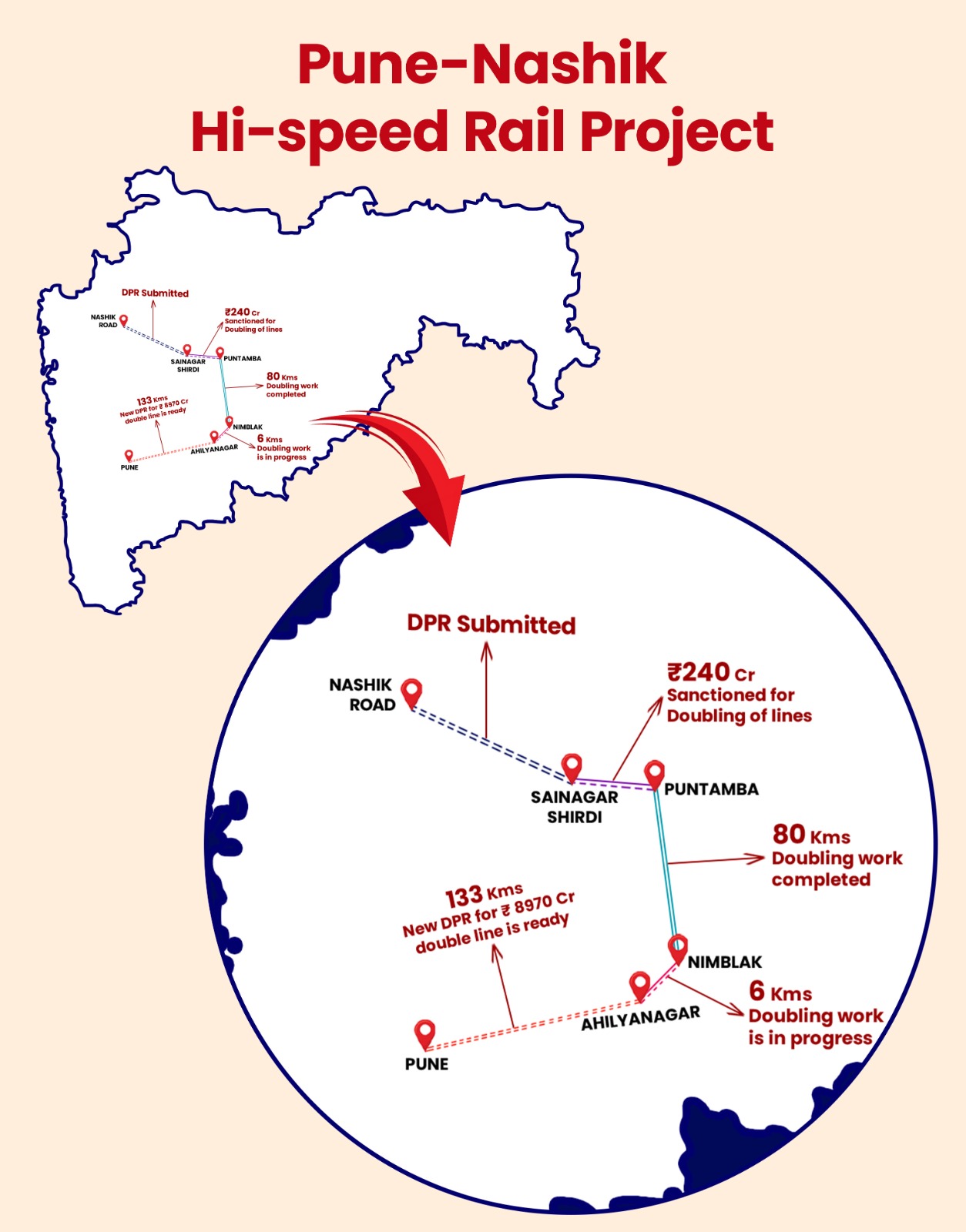
India’s Railways Ministry has cleared a revised alignment for the proposed Pune–Nashik high-speed corridor, a project expected to transform connectivity between two of Maharashtra’s most important economic and cultural centers. Railway Minister Ashwini Vaishnaw confirmed the new route after earlier plans were deemed unfeasible due to interference risks with the Giant Metrewave Radio Telescope, an international observatory supported by 31 countries.
The alternate alignment will link Nashik to Pune via Sainagar Shirdi, Puntamba, Nimblak, Ahilyanagar, and the Chakan Industrial Estate, avoiding the GMRT zone while advancing infrastructure development. Work is already underway: the doubling of the Puntamba–Nimblak line is complete, construction continues on the Nimblak–Ahilyanagar stretch, and detailed project reports for other segments—including a ₹8,970 crore plan for new double lines between Ahilyanagar and Pune—have been prepared.
Officials say the corridor will deliver wide-ranging benefits. Religious and cultural tourism will gain from faster access to Shirdi, Trimbakeshwar, and Pune’s historic forts, while rural tourism and handicraft industries along the route are expected to flourish. Industrial growth is also a key driver, with direct rail connectivity set to boost freight movement, reduce logistics costs, and strengthen the Chakan hub’s position as a national manufacturing powerhouse.
Education and urban development are central to the plan, with improved student mobility and academic collaboration between Nashik and Pune projected to support knowledge-driven sectors. The initiative also ties into the Prime Minister’s Gati Shakti vision, which has already launched 130 multimodal cargo terminals nationwide.
By connecting two major metropolitan regions, enhancing industrial access, and strengthening tourism and education, the Pune–Nashik corridor marks a significant step forward in Maharashtra’s infrastructure modernization.