
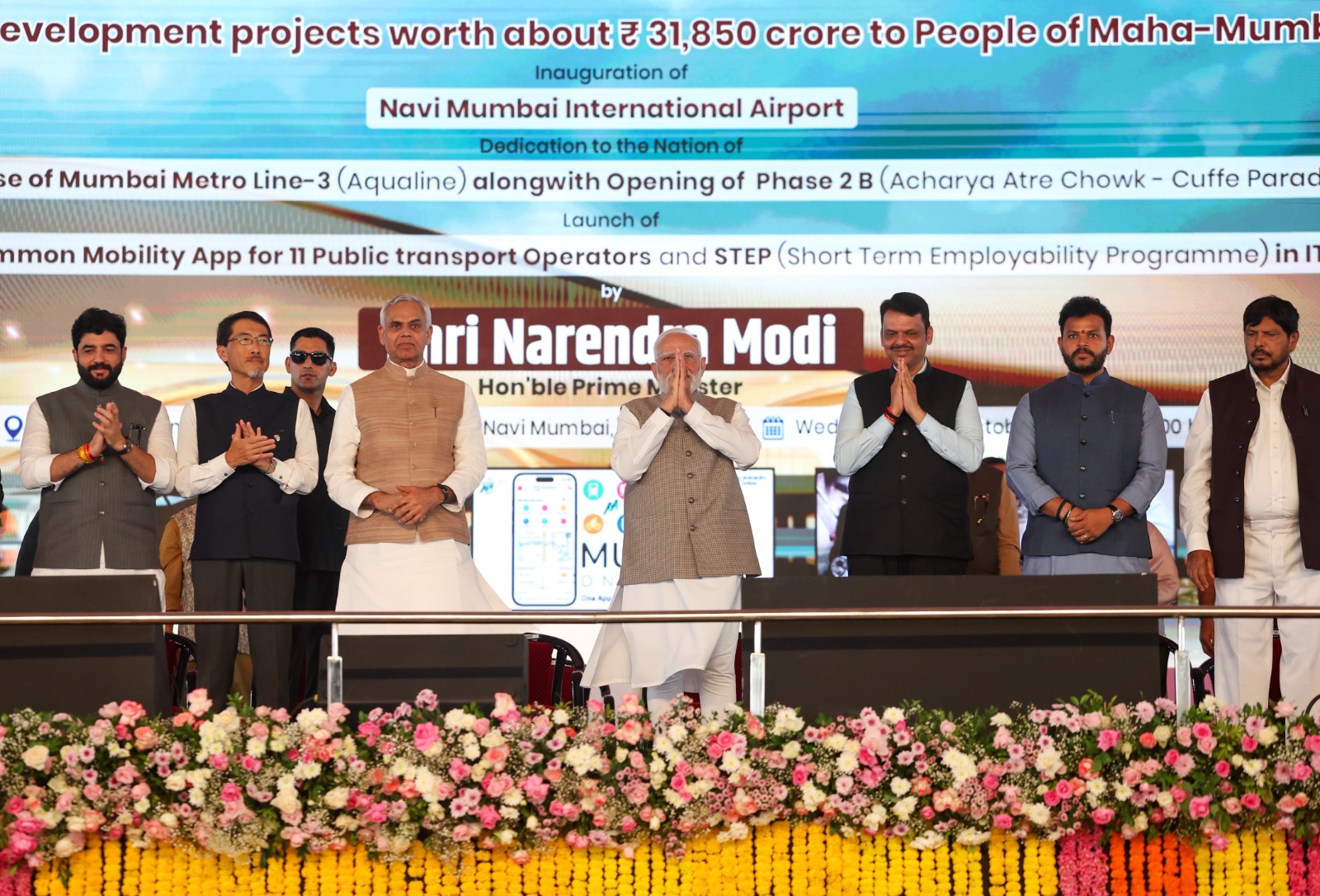
Prime Minister Narendra Modi inaugurated the Phase 1 of Navi Mumbai International Airport (NMIA) and dedicated a series of transformative infrastructure and skill development projects in Mumbai, marking a major milestone in India’s urban and aviation landscape.
The NMIA, developed under a Public-Private Partnership at a cost of approximately Rs 19,650 crore, is India’s largest Greenfield airport project. Designed to handle 90 million passengers annually and 3.25 million metric tonnes of cargo, the airport spans 1160 hectares and features a lotus-inspired terminal symbolizing prosperity and culture. It will operate in tandem with Chhatrapati Shivaji Maharaj International Airport to ease congestion and elevate Mumbai into the ranks of global multi-airport systems.
Among its pioneering features are an Automated People Mover (APM) connecting all four terminals and city-side infrastructure, dedicated storage for Sustainable Aviation Fuel (SAF), 47 MW solar power generation, and EV bus services. NMIA will also be the first airport in India with water taxi connectivity. Modi emphasized that the airport will reduce export costs for small and medium enterprises, connect Maharashtra’s farmers to global markets, and boost investment and employment.
The Prime Minister also inaugurated Phase 2B of Mumbai Metro Line-3, stretching from Acharya Atre Chowk to Cuffe Parade, completing the 33.5 km Aqua Line with 27 stations. Constructed at a total cost of Rs 37,270 crore, this is Mumbai’s first fully underground metro line. It will cater to 13 lakh daily passengers and provide direct access to heritage districts and key financial hubs including Fort, Kala Ghoda, Marine Drive, Bombay High Court, Mantralaya, RBI, BSE, and Nariman Point. Modi praised the engineering feat of building the metro underground while preserving historic structures and criticized previous administrations for delaying the project, which he said caused losses of thousands of crores and prolonged commuter hardship.
To enhance commuter convenience, Modi launched the Mumbai One App, integrating ticketing and real-time updates across 11 public transport operators including metro, monorail, suburban railways, and municipal bus services. The app enables seamless multimodal travel with a single ticket and offers features such as journey updates, alternative routes, and SOS alerts.
In the skill development domain, Modi unveiled the Short-Term Employability Program (STEP), a flagship initiative by Maharashtra’s Department of Skill, Employment, Entrepreneurship, and Innovation. Rolled out across 400 Government ITIs and 150 Technical High Schools, STEP will establish 2,500 training batches, including 364 for women and 408 in emerging technologies such as AI, IoT, EVs, solar energy, and additive manufacturing. Modi also highlighted the Rs 60,000 crore PM Setu scheme linking ITIs with industry and praised Maharashtra’s rollout of new programs in technical institutions.
Addressing the gathering, Modi reiterated his vision of a Viksit Bharat—defined by speed, progress, and public welfare. He cited the expansion of Vande Bharat trains, bullet train projects, expressways, tunnels, and sea bridges as symbols of India’s development. He recalled his 2014 pledge to make air travel accessible to all, including those wearing hawaii chappals, and noted that the number of airports in India has more than doubled from 74 in 2014 to over 160 today. The UDAN scheme, he said, has enabled millions to fly for the first time, making India the world’s third-largest domestic aviation market.
Modi emphasized that the growth of Indian airlines and orders for hundreds of new aircraft are generating demand for pilots, cabin crew, engineers, and ground staff. He announced plans to establish India as a global Maintenance, Repair, and Overhaul (MRO) hub by the end of the decade, creating further employment opportunities.
Highlighting India’s demographic advantage, Modi said the country’s strength lies in its youth and that every policy is geared towards maximizing employment. He cited the Rs 76,000 crore Vadhavan Port project as an example of infrastructure-led job creation and stressed that trade and logistics expansion directly boost employment.
Modi contrasted the current governance model with previous regimes, accusing them of prioritizing power over public welfare and obstructing development through scams and corruption. He referenced the delay in Mumbai Metro Line-3 as emblematic of such misgovernance.
On national security, Modi recalled the 2008 Mumbai terror attacks and criticized the then government for sending a message of weakness. He cited a recent revelation by a senior opposition leader that India’s armed forces were ready to strike Pakistan but were held back due to foreign pressure. Modi demanded clarity on who influenced that decision and asserted that today’s India responds with strength, as demonstrated during Operation Sindoor.
He reiterated the government’s commitment to empowering the poor, neo-middle class, and middle class, noting that GST reforms have made goods more affordable and boosted purchasing power. This Navratri season, he said, saw record sales of consumer goods including scooters, bikes, televisions, and refrigerators.
Modi urged citizens to embrace swadeshi products, stating that buying Indian-made goods keeps wealth within the country and creates jobs. He called on every household to adopt the mantra “This is swadeshi” and imagine the strength India will gain through collective action.
Concluding his address, Modi affirmed that Maharashtra has always led India’s development and pledged continued efforts to enhance the capabilities of every town and village in the state. He extended congratulations to the people of Mumbai and Maharashtra for the new infrastructure and development initiatives.
The event was attended by Governor Acharya Devvrat, Chief Minister Devendra Fadnavis, Union Ministers Ramdas Athawale, Rammohan Naidu Kinjarapu, Murlidhar Mohol, and Japan’s Ambassador to India Keiichi Ono, among other dignitaries.