
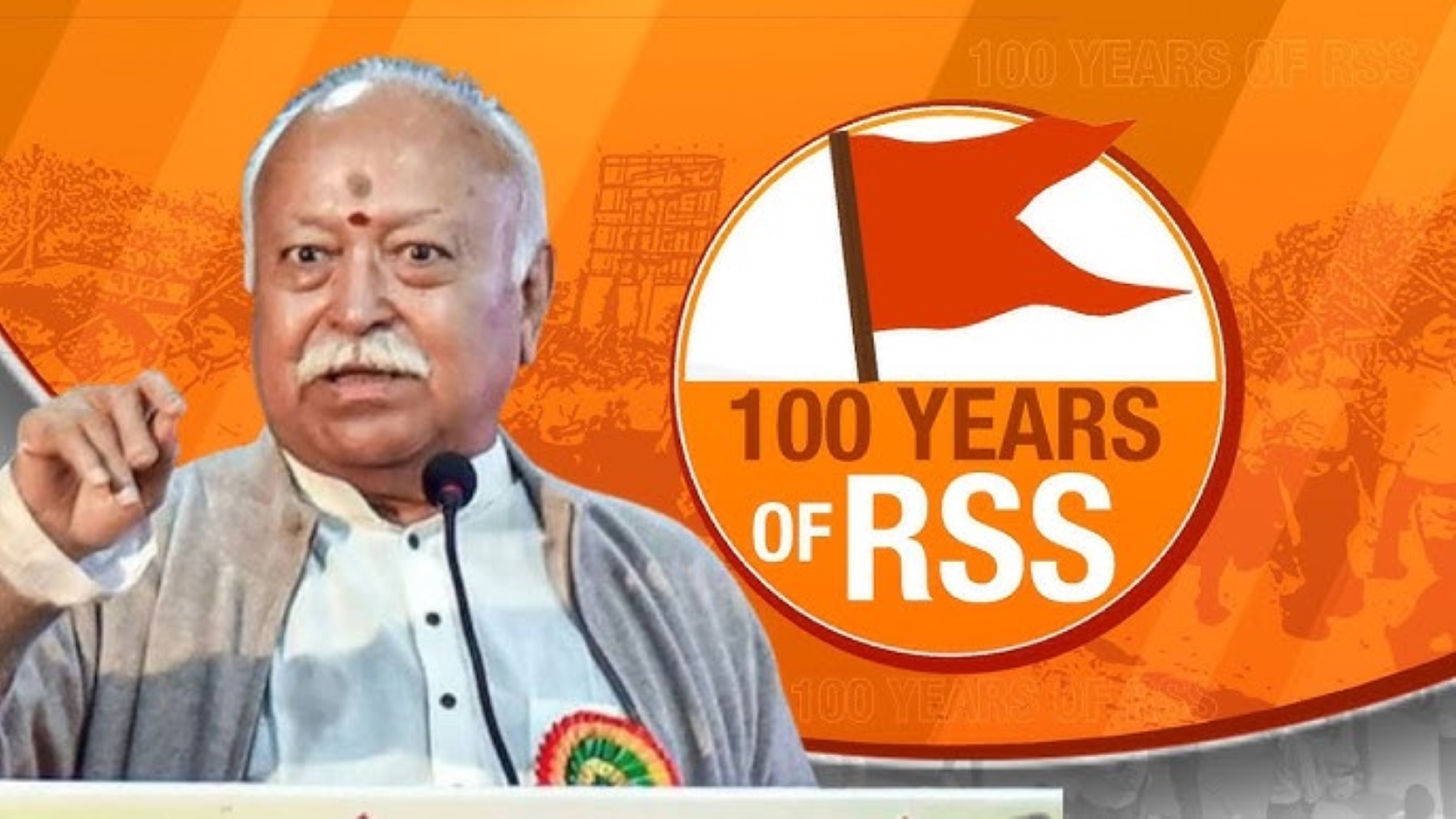
On the opening day of a three-day lecture series titled “100 Years of Sangh’s Journey – New Horizons” held at Vigyan Bhawan, Delhi, Rashtriya Swayamsevak Sangh (RSS) chief Dr Mohan Bhagwat emphasized that the formation of the Sangh was centered on India, and its significance lies in India’s emergence as a global leader. He stated that the Sangh’s inspiration stems from the chant “Bharat Mata Ki Jai,” recited at the end of its prayer, and that its growth has been gradual but unwavering.
Dr Bhagwat clarified that while the Sangh uses the term “Hindu,” its essence is rooted in the inclusive philosophy of Vasudhaiva Kutumbakam—the world is one family. He stressed that the Sangh’s work is driven entirely by its volunteers, who are trained to develop themselves and contribute to society without organizational control. The Sangh considers villages, society, and the nation as its own, and its mission is to organize the entire Hindu society—not in opposition to others, but in harmony with all.
He explained that the Indian concept of a nation is not tied to power or statehood, unlike the Western definition. Even under foreign rule, India remained a nation due to its cultural and civilizational continuity. Reflecting on the freedom struggle, he noted that the failed 1857 uprising awakened a new consciousness, eventually leading to the formation of the Congress. However, post-independence, ideological awakening remained incomplete. Thinkers like Swami Dayanand Saraswati and Swami Vivekanand emphasized returning to India’s roots, a vision carried forward by Dr Keshav Baliram Hedgewar, who founded the Sangh in 1925 to address societal flaws and unify Hindu society.
Dr Bhagwat elaborated that “Hindu” is not merely a religious label but a representation of humanistic values, inclusivity, and respect for all paths. He asserted that India’s unity lies in its geography, resources, and introspective tradition, which teaches that the same essence exists in all beings. Reverence for Bharat Mata and ancestral heritage defines the true Hindu spirit, regardless of the terminology—be it Hindu, Indian, or Sanatani.
He observed that even those who once distanced themselves from the term “Hindu” are gradually embracing it, as improved quality of life leads people back to their roots. The Sangh does not demand that everyone identify as Hindu but affirms that the essence of devotion and cultural continuity unites all. The DNA of India’s people, he said, has remained consistent for 40,000 years.
Dr Bhagwat emphasized that the Sangh was not formed in reaction to any external force and that the concept of a Hindu nation is not linked to power but to unity and shared values. The Sangh’s methodology centers on personal dedication, with Guru Dakshina serving as a symbolic expression of faith and commitment. Volunteers focus on self-development and collective responsibility, aiming to unite rather than divide.
The event was attended by RSS Joint General Secretary Dattatreya Hosabale, North Region Sanghchalak Pawan Jindal, and Delhi Prant Sanghchalak Dr Anil Agarwal. Distinguished guests included retired judges, diplomats, administrative officers, media heads, military veterans, and cultural figures. The lecture series aims to disseminate accurate and truthful information about the Sangh’s century-long journey and its evolving role in shaping India’s future.