
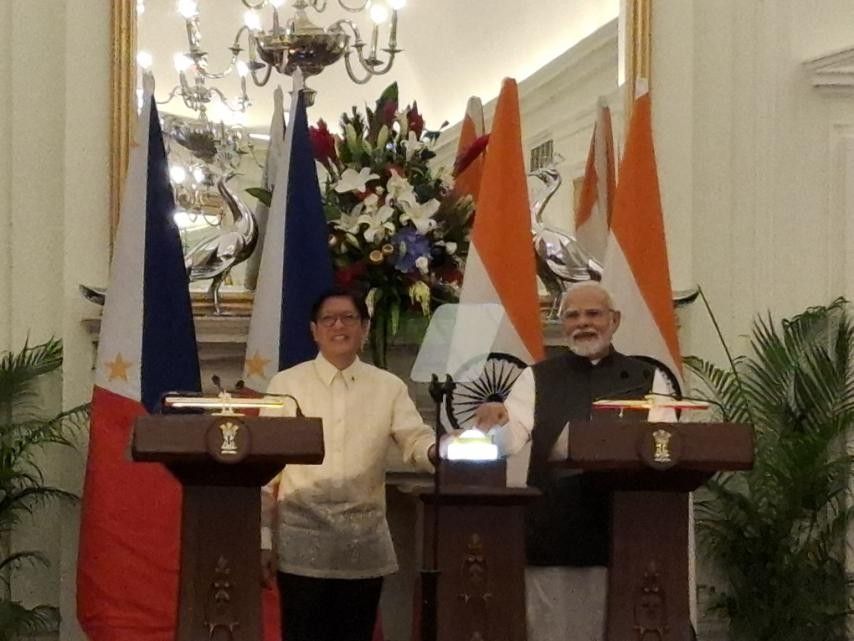
India and the Philippines have officially declared the establishment of a Strategic Partnership, marking a significant milestone in their diplomatic relations. The announcement was made during the state visit of Philippines President Ferdinand Marcos Jr. to India from August 4 to 8, 2025, at the invitation of Prime Minister Narendra Modi. The visit coincided with the seventy-fifth anniversary of diplomatic ties between the two nations.
President Marcos, accompanied by First Lady Louise Araneta Marcos, several Cabinet Ministers, and a high-level business delegation, was accorded a ceremonial reception at Rashtrapati Bhavan and paid floral tributes at Raj Ghat. Bilateral talks between the two leaders were followed by the exchange of documents and a luncheon hosted by Modi. Marcos also met President Droupadi Murmu and External Affairs Minister Dr S Jaishankar, and is scheduled to visit Bengaluru.
The Strategic Partnership is guided by a Plan of Action for 2025–2029 and aims to enhance cooperation across a wide spectrum of areas including political dialogue, defence, maritime security, trade and investment, science and technology, climate action, space, health, agriculture, digital technologies, and cultural exchange. Both leaders reaffirmed their commitment to a free, open, inclusive, and rules-based Indo-Pacific, emphasizing support for ASEAN Centrality.
Political cooperation will be strengthened through regular high-level exchanges, strategic dialogues, and institutional mechanisms such as the Joint Commission on Bilateral Cooperation and Joint Working Groups. Defence and security collaboration will be deepened through joint training, tri-service cooperation, defence industrial partnerships, and maritime engagements including hydrographic surveys and multilateral exercises like MILAN and ASEAN-India Maritime Exercise.
The two countries pledged to expand intelligence sharing and counter-terrorism efforts, including combating cyber threats, terror financing, and transnational crimes. Cybersecurity cooperation will include exchanges on digital infrastructure, artificial intelligence, and digital forensics.
Economic ties are set to grow with bilateral trade reaching approximately Rs 275 billion in 2024–25. Both sides aim to expedite the Preferential Trade Agreement and enhance collaboration in sectors such as renewable energy, critical minerals, electric vehicles, robotics, ICT, biotechnology, infrastructure, and tourism. Joint efforts will also focus on customs facilitation, healthcare, pharmaceuticals, and traditional medicine.
Science and technology cooperation will be advanced through joint research, peaceful uses of nuclear energy and outer space, and ICT applications in education and medicine. Agricultural collaboration will include rice production and sustainable aquaculture.
Connectivity will be boosted through digital, financial, and physical linkages, including direct air connectivity between the capitals and enhanced maritime port-to-port connections. Visa-free travel for Indian tourists to the Philippines and gratis e-tourist visas for Filipinos visiting India were welcomed as steps to promote people-to-people exchanges.
Legal cooperation was reinforced with the conclusion of treaties on mutual legal assistance and transfer of sentenced persons. Cultural ties will be expanded through scholarship programs, tourism exchanges, and academic collaborations. Training and capacity building will continue under the Indian Technical and Economic Cooperation programme.
On the multilateral front, both countries committed to working together in the United Nations and other forums on global issues such as climate change, sustainable development, and reform of the UN Security Council. They emphasized the importance of international law, particularly the 1982 UN Convention on the Law of the Sea, and reaffirmed the 2016 Arbitral Award on the South China Sea as a basis for peaceful dispute resolution.
India and the Philippines expressed concern over coercive actions in the South China Sea and called for restraint and peaceful resolution of disputes. They pledged to deepen engagement under the ASEAN framework and the ASEAN Outlook on the Indo-Pacific, and to continue cooperation through platforms like the Voice of the Global South Summit.
The declaration concluded with a reaffirmation of the enduring spirit of the Treaty of Friendship signed in 1952, underscoring the shared determination to advance the strategic partnership for regional peace, stability, and prosperity.