



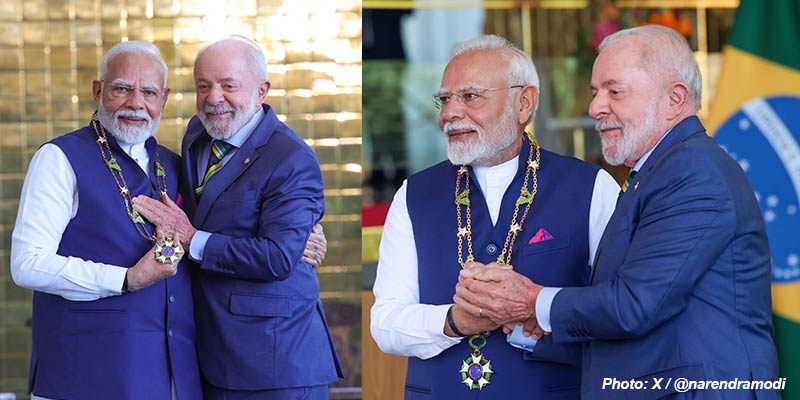
Prime Minister Narendra Modi undertook a State Visit to Brazil on the invitation of President Luiz Inácio Lula da Silva, reaffirming nearly eight decades of enduring bilateral friendship and trust. The two leaders elevated the India-Brazil Strategic Partnership with a sweeping joint statement that charted a roadmap for the next decade across five priority pillars: defence and security, food and nutritional security, energy transition and climate change, digital transformation and emerging technologies, and industrial partnerships in strategic areas.
Emphasising convergence in defence and security, the leaders welcomed growing cooperation, including joint military exercises and high-level defence engagements. They noted the signing of the Agreement on the Exchange and Mutual Protection of Classified Information and launched a Bilateral Cybersecurity Dialogue. Modi expressed appreciation for Brazil’s unequivocal condemnation of the terrorist attack in Pahalgam, Jammu and Kashmir. The two sides jointly condemned terrorism in all forms, welcomed the new Agreement on Cooperation in Combating International Terrorism and Transnational Organized Crime, and called for action against all UN-designated terrorist entities, including those listed by the 1267 Sanctions Committee. The leaders reaffirmed commitment to disrupt terror financing through the UN and FATF mechanisms. They praised the adoption of the UN Convention on Cybercrime and pledged support for its signing in Hanoi later in 2025. They also committed to expanded space and maritime cooperation, and welcomed Brazil’s support for India’s non-permanent UN Security Council candidature for 2028–29. Both sides reiterated mutual backing for each other’s permanent membership in an expanded Security Council, underscoring the need for urgent reform.
On food and nutritional security, the two leaders reaffirmed their commitment to development, social inclusion, eradicating hunger by 2030, and enhancing productivity through sustainable agriculture. They voiced support for public stockholding for food security and resisted unilateral trade restrictions disguised as environmental or security measures. They endorsed joint research in agricultural productivity, animal genetics, biotechnology, and nutrition, and supported the Global Alliance Against Hunger and Poverty.
In the energy and climate domain, both countries celebrated their collaboration on biofuels and reconfirmed their founding membership of the Global Biofuels Alliance. They emphasised the importance of sustainable transitions through technology-neutral pathways, noting the role of biofuels and flex-fuel vehicles in transport decarbonisation. They acknowledged Sustainable Aviation Fuel as a viable solution and endorsed joint deployment initiatives. India welcomed Brazil’s Tropical Forests Forever Fund initiative and expressed readiness to participate in the COP30 Circle of Finance Ministers and the USD 1.3 trillion “Baku to Belém Roadmap.” Both leaders reaffirmed shared climate commitments under the UNFCCC, Kyoto Protocol, and Paris Agreement, highlighting their alignment with ISA and CDRI in third countries. India extended full support to Brazil’s presidency of COP30 in Belém in November 2025. The leaders also reiterated support for the Seville Commitment on development financing, advocated scaling up Official Development Assistance by developed nations, and reaffirmed their drive to implement the 2030 Agenda.
On digital transformation and emerging technologies, the leaders welcomed the signing of an MoU on Digital Public Infrastructure to develop joint pilot projects, foster capacity building, and institutional cooperation. They agreed to pursue multilateral alignment on digital governance, particularly on AI risks and benefits. Brazil congratulated India on hosting the 2026 AI Summit. Both sides called for renewed engagement between innovation ecosystems, startups, and research institutions across key areas such as AI, quantum tech, renewable energy, and outer space.
In the strategic industrial domain, Modi and Lula agreed to expand bilateral trade and explore complementarities in pharmaceuticals, defence equipment, mining and minerals, and oil and gas. They encouraged Indian pharma companies’ deeper presence in Brazil and endorsed joint R&D for new medicines, including tropical disease treatments. Defence industries were urged to establish partnerships across land, naval, and aerial domains. The leaders emphasised critical minerals’ significance for clean energy tech and proposed joint exploration, processing, and recycling initiatives. They encouraged joint projects in offshore oil fields and carbon abatement technologies. Both governments will address non-tariff trade barriers and ease visa processes to boost tourism and business travel. They instituted a high-level Commerce and Trade review mechanism to monitor progress. Entrepreneurs and chambers of commerce from both countries were urged to collaborate, leveraging the Brazil-India Business Council. They welcomed Exim Bank of India’s new office in São Paulo and Brazil’s ANVISA representation in Delhi.
Cultural, educational, and people-to-people ties also received prominence. The two leaders welcomed renewals in cultural cooperation and acknowledged student exchanges under Brazil’s PEC and India’s ICCR programmes. They agreed to explore capacity-building in defence and education, and noted Brazil’s participation in the 2025 APAIE conference in New Delhi.
Six agreements and MoUs were signed during the visit: on combating terrorism and organised crime, classified information exchange, renewable energy cooperation, agricultural research, digital transformation, and intellectual property cooperation. The two sides directed authorities to expedite finalisation of agreements on mutual legal assistance in civil matters, defence industry cooperation, sports, archival cooperation, and the 2025–2029 Cultural Exchange Programme.
Modi thanked Lula for the warm hospitality during his State Visit and participation in the 17th BRICS Summit. Lula accepted the invitation to visit India at a mutually convenient date. Both leaders concluded by reaffirming their shared vision of a plural, resilient, and inclusive world, committed to peace, prosperity and sustainable development underpinned by the unique contributions of Brazil and India to global affairs.
