
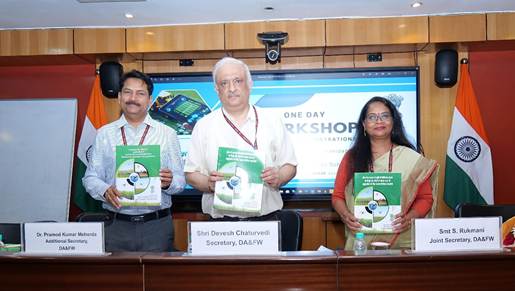
The Ministry of Agriculture and Farmers’ Welfare held a national workshop in New Delhi to promote the implementation of the upgraded Centralised Direct Benefit Transfer (DBT) Platform Version 2.0 and the NaMo Drone Didi Yojana. Secretary of the Department of Agriculture and Farmers’ Welfare, Devesh Chaturvedi, presided over the event, which was attended by senior ministry officials, state-level agriculture and rural development departments, and lead fertiliser companies.
In his address, Chaturvedi underlined the role of digital platforms in enhancing the accountability and efficiency of agricultural schemes, stating that the DBT portal’s new version and the associated Drone Portal are designed to eliminate opacity and ensure equitable access to subsidy benefits. He stressed the importance of agricultural mechanisation, especially for marginal and small farmers, and reiterated the government’s commitment to improving delivery systems for inclusive development.
The workshop witnessed the unveiling of crop-specific Standard Operating Procedures for drone-based application of soil and plant nutrients. These SOPs, intended to guide uniform and scientific drone usage in agriculture, were released during the inaugural session and shared with states for broader adoption.
The NaMo Drone Didi Yojana, a flagship initiative of the central government, was also spotlighted. It aims to train and equip women from Self-Help Groups to operate drones in agriculture for tasks such as fertiliser and pesticide spraying. A dedicated Drone Portal has been developed to facilitate real-time tracking, training, certification, and operational mapping. The portal features a comprehensive dashboard accessible to all stakeholders.
The workshop also featured live demonstrations of the Centralised DBT Platform Version 2.0 and the Drone Portal, enabling state nodal officers to engage directly with the systems’ features, workflows, and protocols. These upgrades are positioned as a solution to persistent problems such as delays in subsidy disbursement and lack of operational transparency under the Sub-Mission on Agricultural Mechanisation (SMAM).
Participants from various states shared practical feedback, field experiences and local innovations to help shape future implementations. The Ministry stated that insights from this interactive session will be instrumental in refining digital platforms and developing a forward-looking roadmap for agricultural mechanisation.