
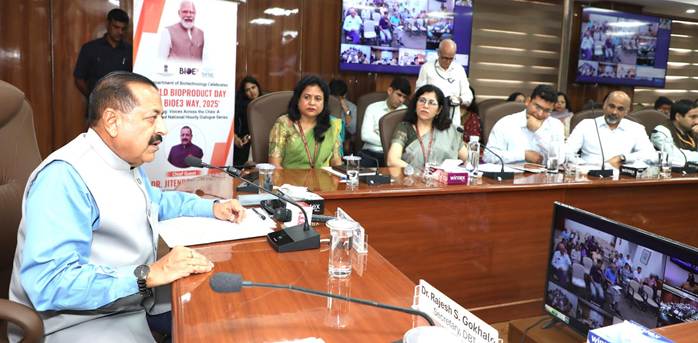
Union Minister for Science and Technology Jitendra Singh reiterated the government’s commitment to building a $300 billion bioeconomy by 2030 and called for inclusive national participation during the celebration of World Bioproduct Day. Speaking at the event themed The BioE3 Way, Singh urged that “every Indian is a stakeholder in India’s biotech mission,” and highlighted the power of grassroots engagement and decentralised innovation.
The event introduced a pioneering nationwide experiment: Voices Across the Cities, an hourly, city-synchronised dialogue series hosted by academic and research institutions across India. Over eight hours, institutions led theme-based discussions on marine biomass, industrial valorisation, forest resources, and agri-residue solutions, showcasing regional bio-innovation while underlining the diversity of India’s bioproduct landscape.
Calling the initiative a “beautiful hybrid model,” Singh said it represented more than a scientific occasion—it was an outreach movement that brought students, entrepreneurs and industry voices into the heart of the national biotech narrative. He emphasised that sustaining biotech startups is more challenging than starting them and underscored the importance of early-stage financing and robust industry collaborations.
He noted that India has seen exponential growth in its biotech ecosystem, with the number of startups rising from about 50 a decade ago to nearly 11,000 today. This was credited to supportive policy initiatives and institutional backing. Singh also referred to the recently launched BioE3 Policy, which aligns environmental sustainability, economic growth, and social equity under a cohesive bioeconomy vision.
“Bioproducts are no longer confined to the lab—they are about livelihoods,” he said, citing the use of biodegradable packaging, eco-conscious personal care products, and job creation across green sectors. He argued that the next industrial revolution will be bio-led, with India emerging at its forefront.
The Minister acknowledged systemic challenges faced by students in pursuing biotech due to a mismatch between talent and societal expectations. He praised the National Education Policy 2020 as a “game-changer,” noting that it enables students to pursue their interests with flexibility and purpose.
Singh called on stakeholders to value India’s natural wealth and traditional knowledge systems, which attract foreign researchers yet remain underutilised domestically. He also underscored the need for strong science communication through social media, storytelling in local languages, and showcasing biotech’s profitability and livelihood potential.
Secretary of the Department of Biotechnology and Chair of BIRAC, Rajesh S. Gokhale, outlined concrete steps being taken to operationalise the BioE3 Policy. These include region-specific innovation missions, scaled pilot manufacturing support, and a more efficient pipeline linking research to commercialisation. Gokhale underscored the importance of partnerships between academia, startups, and industries in ensuring scalability and sustainability.
Asserting that biotech is no longer limited to elite labs but reaches into India’s farms, forests, oceans, and factories, Singh proposed that future editions of the programme should include direct participation from farmers, fishermen, and other non-scientific stakeholders. “Let them tell us what they need from science—and what science must deliver for them,” he said.
As India seeks to build an innovation-driven, sustainable economy, the Minister concluded with a resounding message that biotechnology must be understood as a mission that serves every Indian—not just scientists.