



Researchers at the Raman Research Institute (RRI), an autonomous institute under the Department of Science and Technology, have uncovered a new method for detecting topological invariants in quantum materials, paving the way for breakthroughs in next-generation technologies such as quantum computing, fault-tolerant electronics, and energy-efficient systems.
The study, led by Professor Dibyendu Roy and PhD researcher Kiran Babasaheb Estake, focuses on momentum-space spectral function (SPSF) analysis, a revolutionary approach to identifying hidden topological structures in materials like topological insulators and superconductors, where electrons exhibit unique behaviors based on quantum-level geometries.
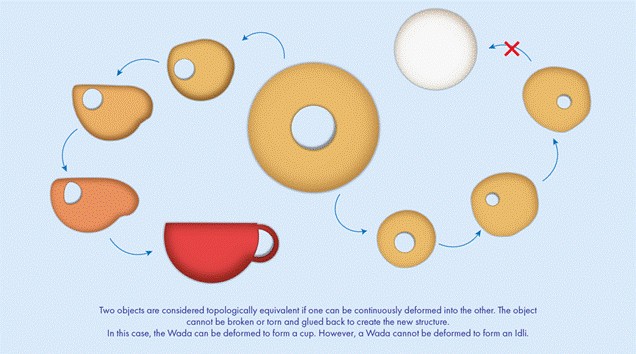
Topological invariance refers to properties that remain unchanged under continuous deformations, akin to the mathematical concept of shape equivalence, where a wada (donut) and a coffee cup share topological similarity due to having one hole, but a wada and an idli are topologically distinct. In quantum systems, similar principles apply, where winding numbers (1D systems) and Chern numbers (2D systems) determine electron behavior within a material.
Traditional detection methods rely on Angle-Resolved Photoemission Spectroscopy (ARPES), but the RRI team demonstrated that spectral functions inherently contain topological signatures, enabling indirect visualization of material properties without direct observation. The findings, published in Physical Review B, open new avenues for exploring and classifying quantum materials, reinforcing India’s leadership in condensed matter physics and advanced electronics research.
Estake emphasized the long-standing use of spectral functions in probing density of states and dispersion relations, noting that their ability to reveal topological characteristics was previously overlooked. He stated, “We have demonstrated through various examples that the spectral function also contains signatures about the topology of a system,” indicating the study’s potential for universal applicability across quantum materials.
This breakthrough has profound implications for quantum computing, ultra-fast electronic systems, and sustainable energy technologies, positioning India at the forefront of cutting-edge research in exotic materials and fundamental physics
