

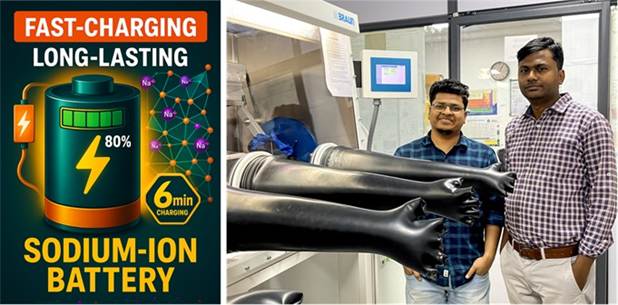
In a groundbreaking achievement, researchers at the Jawaharlal Nehru Centre for Advanced Scientific Research (JNCASR), an autonomous institute under the Department of Science and Technology (DST), have developed a revolutionary sodium-ion battery (SIB) with ultra-fast charging capability and extended lifespan. This innovation is poised to play a critical role in India’s transition to self-reliant energy storage solutions, significantly reducing dependence on costly imported lithium.
Led by Associate Professor Premkumar Senguttuvan and Ph.D. scholar Biplab Patra, the research team has successfully engineered a NASICON-type cathode and anode material that enables the battery to charge up to 80% in just six minutes and withstand over 3,000 charge cycles. This breakthrough addresses the longstanding limitations of conventional sodium-ion batteries, which often suffer from slow charging speeds and short operational lifespans.
The key to this cutting-edge advancement lies in optimizing the anode material—Na.V.Al.Nb.(PO)—through three pivotal modifications. First, the researchers reduced particle size to the nanoscale, enhancing ion mobility. Second, they applied a thin carbon coating to improve conductivity and stability. Third, they introduced aluminum to further enhance performance, ensuring faster and safer movement of sodium ions.
Sodium-based batteries offer several advantages over lithium-ion counterparts. Sodium is abundantly available in India, unlike lithium, which remains a scarce and imported resource. By shifting to sodium-ion technology, India moves closer to achieving its Atmanirbhar Bharat mission, reducing foreign dependence on battery materials while boosting domestic innovation.
Beyond affordability, these sodium-ion batteries hold immense potential to transform multiple sectors. From electric vehicles and solar power storage to drones and rural electrification, this technology can drive India’s clean energy revolution by providing a safer, efficient, and scalable solution for widespread energy needs.
The battery’s reliability has been validated using advanced electrochemical cycling and quantum simulations, ensuring its robustness for real-world applications. Importantly, its design minimizes fire hazards and degradation risks commonly associated with traditional lithium-based energy storage systems.
While further development and commercialization efforts are needed, this breakthrough places India at the forefront of global battery innovation. With growing recognition from the scientific community and continued support, the nation may soon emerge as a leader in next-generation green energy storage technology. The discovery underscores India’s commitment to pioneering sustainable solutions that will shape the future of electrification worldwide.