

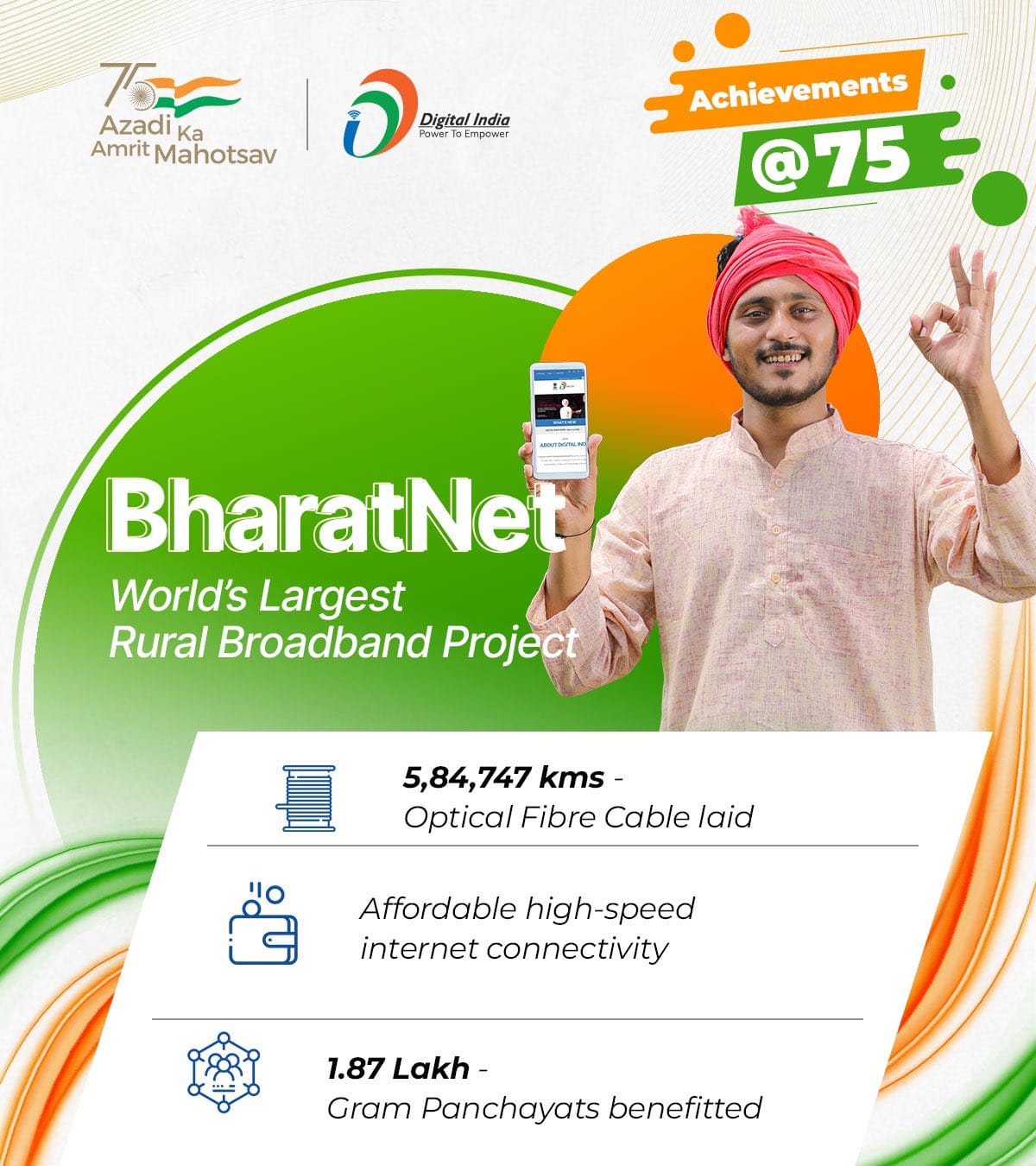
BharatNet, the flagship rural broadband initiative of the Government of India, continues to reshape the landscape of digital access across the nation with the mission of connecting every Gram Panchayat and rural household to high-speed internet. As of March 19, 2025, a total of 218,347 Gram Panchayats have been made service-ready, reflecting a major stride in one of the world’s largest rural telecom infrastructure projects. The BharatNet network has now laid 692,676 km of Optical Fiber Cable (OFC), and the OFC route length has expanded to 4.213 million km as of March 25, 2025. Over 1.22 million Fibre-to-the-Home (FTTH) connections have been commissioned and more than 104,000 Wi-Fi hotspots have been installed under this project.
BharatNet is envisioned as a vehicle to provide unrestricted broadband access to all telecom service providers, enabling services such as e-governance, e-health, e-education, digital banking, and content delivery in rural and remote areas. This ensures that mobile operators, internet service providers, cable TV companies, and other digital content suppliers can extend their networks using the BharatNet backbone. By bridging the urban-rural digital divide, BharatNet seeks to drive inclusive economic growth and enable the rural population to engage with the mainstream digital economy.
Originally targeting 250,000 Gram Panchayats, BharatNet was approved for execution in three phases. Phase I, completed in December 2017, connected 100,000 Panchayats primarily using existing government infrastructure. Phase II, currently underway, aims to cover an additional 150,000 Panchayats through a combination of optical fiber, radio, and satellite-based technologies. This phase also introduced collaboration with state governments and private sector participants. Phase III, which has also commenced, focuses on making the network future-proof by integrating 5G readiness, boosting bandwidth capacity, and ensuring robust last-mile connectivity to homes and public institutions.
In August 2023, the government approved the Amended BharatNet Program (ABP), a design upgrade aimed at covering 264,000 Gram Panchayats with optical fiber in ring topology. The amended program also provides on-demand optical fiber connections to non-Panchayat villages. With a budget outlay of 1.39579 trillion rupees, the ABP includes deployment of an IP-MPLS (Internet Protocol-Multi-Protocol Label Switching) architecture with routers at block and Panchayat levels, a 10-year commitment to operations and maintenance, uninterrupted power backup, and a Remote Fibre Monitoring System for network management.
Funding for the BharatNet initiative comes primarily from the Digital Bharat Nidhi, which replaced the earlier Universal Service Obligation Fund. The total approved funding for Phase I and II stands at 420.68 billion rupees, excluding taxes and local levies. By December 31, 2023, 398.25 billion rupees had already been disbursed toward implementation of the project. Execution is overseen by Bharat Broadband Network Limited (BBNL), a Special Purpose Vehicle created in February 2012. Under the revised program, Bharat Sanchar Nigam Limited (BSNL) has been designated as the sole Project Management Agency for the entire network’s operations and maintenance.
The last-mile access of the BharatNet network is achieved via a combination of leased bandwidth, dark fiber, public Wi-Fi, and direct Fibre-to-the-Home installations. Government institutions such as schools, hospitals, and post offices are being connected through FTTH as part of the plan to bring digital services directly to citizens.
A significant portion of the on-ground deployment is driven by CSC e-Governance Services India Limited, which is responsible for establishing last-mile connections in villages. As of September 2024, CSC had installed 104,574 Wi-Fi access points and delivered over 1.14 million FTTH connections. Additionally, CSC carried out a pilot initiative using overhead optical fiber to extend connectivity.
BharatNet is further complemented by parallel efforts such as the Pradhan Mantri Gramin Digital Saksharta Abhiyan (PMGDISHA), which trained over 63.9 million rural residents in basic digital literacy by March 2024. Another initiative, the National Broadband Mission (NBM), launched in 2019 and upgraded to NBM 2.0 in January 2025, aims to rapidly build out the country’s digital infrastructure. Central to this effort is the GatiShakti Sanchar portal, which simplifies Right of Way approvals to speed up the rollout of digital infrastructure.
A Memorandum of Understanding signed between Digital Bharat Nidhi and the National Bank for Agriculture and Rural Development seeks to deepen the reach of digital services in villages. The collaboration focuses on data and content sharing, awareness and training, and integration of ICT infrastructure to promote financial inclusion and digital governance.
As of December 2024, mobile connectivity extended to 625,853 villages across India, including 618,968 with 4G coverage. These efforts are seen as complementary to BharatNet, collectively working to eliminate the digital divide by expanding mobile broadband and digital accessibility in underserved regions.
BharatNet’s socio-economic impact is already visible. It has enabled villages to host digital classrooms, telemedicine centers, and government service delivery kiosks. It has opened new avenues for digital entrepreneurship and created gateways for rural participation in national and global economies. It has enhanced the efficiency of local governance by enabling Gram Panchayats to implement technology-driven solutions and monitor welfare delivery mechanisms more effectively.
With Phase II and Phase III underway, BharatNet remains a critical pillar of India’s ambition to become a digitally empowered society. The project’s integration with emerging technologies like 5G and its emphasis on robust infrastructure, sustainability, and scalability reflect a long-term vision of equitably distributing the benefits of the internet revolution to the remotest corners of the country.