
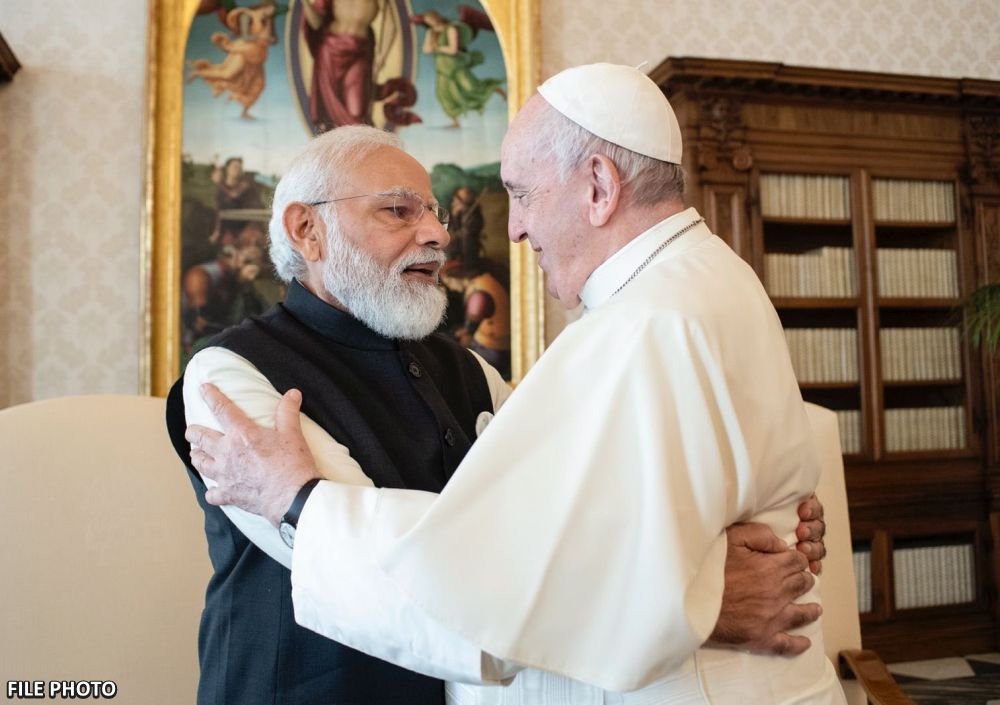
Prime Minister Narendra Modi today expressed deep sorrow at the passing of His Holiness Pope Francis, calling him a beacon of compassion, humility, and spiritual courage. In a message shared with the world, Modi extended his heartfelt condolences to the global Catholic community and praised the Pope’s lifelong dedication to serving humanity. “From a young age, he devoted himself towards realising the ideals of Lord Christ. He diligently served the poor and downtrodden. For those who were suffering, he ignited a spirit of hope,” the Prime Minister said. Reflecting on his personal encounters with the Pope, Modi added, “I fondly recall my meetings with him and was greatly inspired by his commitment to inclusive and all-round development. His affection for the people of India will always be cherished.”
The Pope passed away peacefully in the early hours of April 21, 2025, at the age of 88, following a prolonged period of declining health. In his final days, he remained engaged in spiritual and public life, delivering his last Easter message from the Vatican with characteristic grace. His death marks the end of a profound era in the Catholic Church—a papacy that spanned over a decade and redefined the global role of religious leadership in the 21st century.
Born Jorge Mario Bergoglio in Buenos Aires, Argentina, in 1936, he became the first Latin American and the first Jesuit to ascend to the papacy, elected on March 13, 2013. From his first moments on the balcony of St. Peter’s Basilica, Pope Francis stood out. He chose simplicity, humility, and closeness to people as the foundation of his papacy. He rejected papal opulence and adopted the name “Francis” in honor of Saint Francis of Assisi, the champion of peace and poverty. This symbolic choice signaled the tone of his pontificate—one centered on mercy, dialogue, service, and reform.
Throughout his tenure, Pope Francis was a powerful voice for the voiceless. He consistently called attention to poverty, inequality, climate change, and migration. He spoke candidly against clericalism, abuse within the Church, and the moral complacency of modern society. He inspired movements for social justice and encouraged interfaith dialogue. His bold encyclicals and speeches called on leaders and common citizens alike to view the world with compassion and moral responsibility.
India held a special place in Pope Francis’s heart. His 2021 meeting with Prime Minister Narendra Modi in the Vatican was a moment of warmth and historic resonance. The two leaders shared a nearly hour-long private conversation, reflecting mutual respect and concern for global peace, inclusive growth, and spiritual harmony. During the meeting, Modi extended a formal invitation for the Pope to visit India—a country that had not hosted a papal visit since 1999. The Pope, deeply moved by the invitation, expressed enthusiasm for traveling to India, a land of diverse faiths and ancient spiritual traditions.
Though the visit never materialized in his lifetime, preparations were underway for a potential journey following the Catholic Church’s Jubilee Year of 2025. It would have been a landmark moment in Vatican-India relations. The visit would have strengthened the centuries-old connection between the Indian subcontinent and the Holy See—built not just on diplomacy but on shared values of tolerance, charity, and community.
India is home to a vibrant and devout Catholic population, estimated at over 23 million. The Catholic community here is one of the largest in Asia and is composed of three major rites: the Latin Church, the Syro-Malabar Church, and the Syro-Malankara Church. Each contributes uniquely to India’s cultural and spiritual fabric. Catholic educational institutions, hospitals, and charitable organizations have served the country for generations, particularly in rural and underserved regions.
Pope Francis’s teachings found a deep resonance in the hearts of Indian Catholics. His appeals for ecological justice echoed in the green activism of many Indian dioceses. His openness toward dialogue and forgiveness was mirrored in countless community efforts for interreligious harmony across India. The Pope’s advocacy for the poor and the marginalized inspired new energies within church-led social services in tribal, Dalit, and economically backward communities.
In his annual homilies and major addresses, Pope Francis often spoke of the “Church as a field hospital”—a place where the wounded of society could find healing and dignity. Indian Catholics took those words to heart, leading programs focused on education, nutrition, healthcare, and employment generation. His famous assertion, “Who am I to judge?” in relation to LGBTQ+ individuals, was also appreciated in more progressive corners of the Indian Church as a gesture toward inclusion and understanding.
For many in India, the Pope’s moral clarity during times of international upheaval was a guiding light. He raised his voice during conflicts, natural disasters, and refugee crises—always emphasizing peace and the sanctity of life. He saw the world not through the lens of politics but through a profound humanism rooted in faith.
Even outside the Catholic community, Pope Francis was respected across India. People of other faiths admired his simplicity and his ability to bridge divides. Religious leaders from Hindu, Muslim, Sikh, Buddhist, and Jain traditions often cited his message of unity and compassion as aligning with their own values. He was seen not only as the head of a Church but as a spiritual statesman of the world.
His papacy was also marked by his push for Vatican reforms. He restructured key departments, focused on financial transparency, and encouraged synodality—a model where decisions are made collectively and with broader consultation. His recent emphasis on the empowerment of women within the Church and his interest in decentralized, localized Church governance reflected his commitment to reform from within.
His concern for climate change, articulated most clearly in his encyclical “Laudato Si’,” influenced India’s own climate action networks. He connected environmental destruction with the suffering of the poor, calling for an “integral ecology” that India’s tribal communities, farmers, and spiritual traditions easily understood and valued.
Today, as Indian Catholics gather in churches across the nation to pray for the soul of Pope Francis, there is a deep and personal sense of loss. Bishops, priests, nuns, and laypersons alike are reflecting on his teachings, his love for the poor, and his vision of a Church that listens, walks, and serves. Across schools, parishes, and seminaries, his words and legacy are being remembered not just as history, but as a continuing mission.
For India, his death is not merely a moment of mourning—it is also a time to reflect on what he stood for. His life was an example of how faith can be lived through service, how power can be tempered by humility, and how leadership must be rooted in empathy. His vision of inclusive development and compassion aligns with the hopes of millions in India.
As the world bids farewell to a beloved shepherd, India remembers him not just as the Pope but as a friend, a teacher, and a moral compass. His image sitting in quiet prayer, walking among the poor, or greeting children with a warm smile will remain etched in the hearts of people far beyond Rome.
In the end, Pope Francis’s legacy is not confined to the halls of the Vatican—it lives on in the millions of lives he touched, including in the villages, towns, and cities of India. He once said, “The future does have a name, and its name is hope.” That hope, now carried forward by the faithful around the world, is perhaps the most fitting tribute to a Pope who never stopped believing in the goodness of people.